
10 Yard
ResidentialBest for garage cleanouts, small bathroom renovations, or garden debris.
Starting at $325 / 7 Days
- 2 Tons Included
- Driveway Protection
- ~12 ft × 7.5 ft × 4 ft
Dumpster Rental 101
Most delivery problems are preventable. The drop zone, the clearance overhead, and the access path each take five minutes to confirm before the truck arrives — and hours to fix if something is wrong on delivery day.
These dumpster delivery tips for Longview, TX take fifteen minutes to act on and can prevent a failed delivery, a trip fee, and a full day of lost time. A failed delivery resets the delivery window by at least a day and leaves your crew without a container on a morning they planned to fill it. The cause is almost always the same: something in the drop zone that was not moved the night before, an overhead clearance that was never measured, or access information that was not communicated at booking.
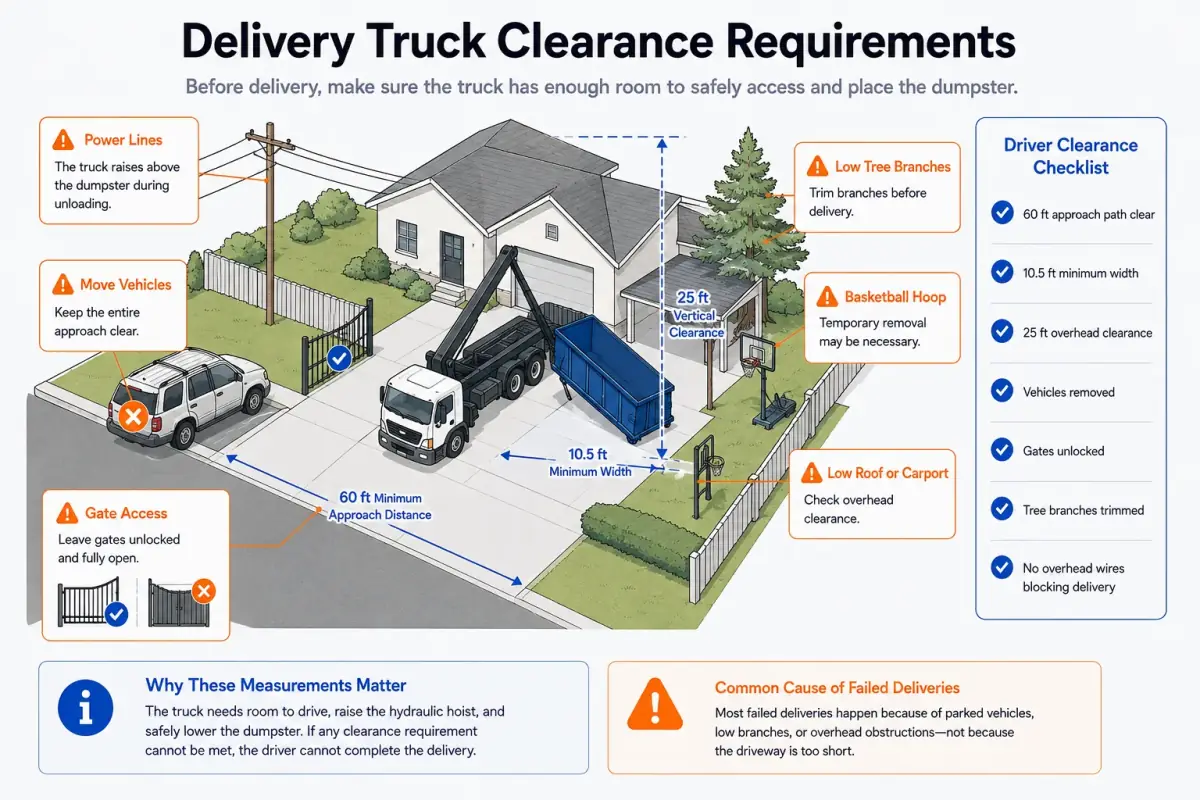
Roll-off delivery in Longview and Gregg County uses hook-lift or cable-hoist trucks that require three things from the placement spot: room to drive in, room to swing the container down, and nothing blocking the approach overhead.
Length: 60 feet, clear. This measures from the front of the truck to the back of the container landing zone. If the truck backs in from the street, count from the back of the intended placement spot to any obstacle — fence, garage door, wall, or parked vehicle. A standard residential driveway from street to garage runs 20 to 30 feet — long enough for the container footprint but not for the truck cab and bed behind it. In that case, the truck typically blocks the street temporarily during the drop. Telling us this when you book your dumpster rental in Longview, TX lets the driver plan the approach.
Width: 10.5 feet. Measure the narrowest point the truck must pass through to reach the placement spot. A single-car driveway in Longview runs 9 to 10 feet at the curb — borderline for the equipment width. If the driveway widens closer to the garage, the truck can often thread a short narrow section. Describe the driveway configuration when you call and we can tell you whether the approach is workable before you book.
Vertical clearance: 25 feet. This is the number most people underestimate in East Texas. Loblolly pine canopies — common in established Longview neighborhoods east of Loop 281 and along the older streets near Pine Tree and Judson — can put branches at 20 to 22 feet of effective clearance over a driveway that looks completely open from the street. Residential power lines in Longview run between 18 and 25 feet over the roadway, and the hook-lift arm extends above the container during the drop cycle. Carport overhangs are another consistent failure point. Walk the full path from the street to your intended drop zone and look up, not just forward.
These three dimensions are physical constraints of the equipment. They do not flex based on the driver's experience or the urgency of the job. If a spot does not clear all three, the driver will not attempt the delivery — and a trip fee applies regardless of the reason.
Once the clearance is confirmed, the next job is the surface — where the container lands and what is underneath it for the duration of the rental.
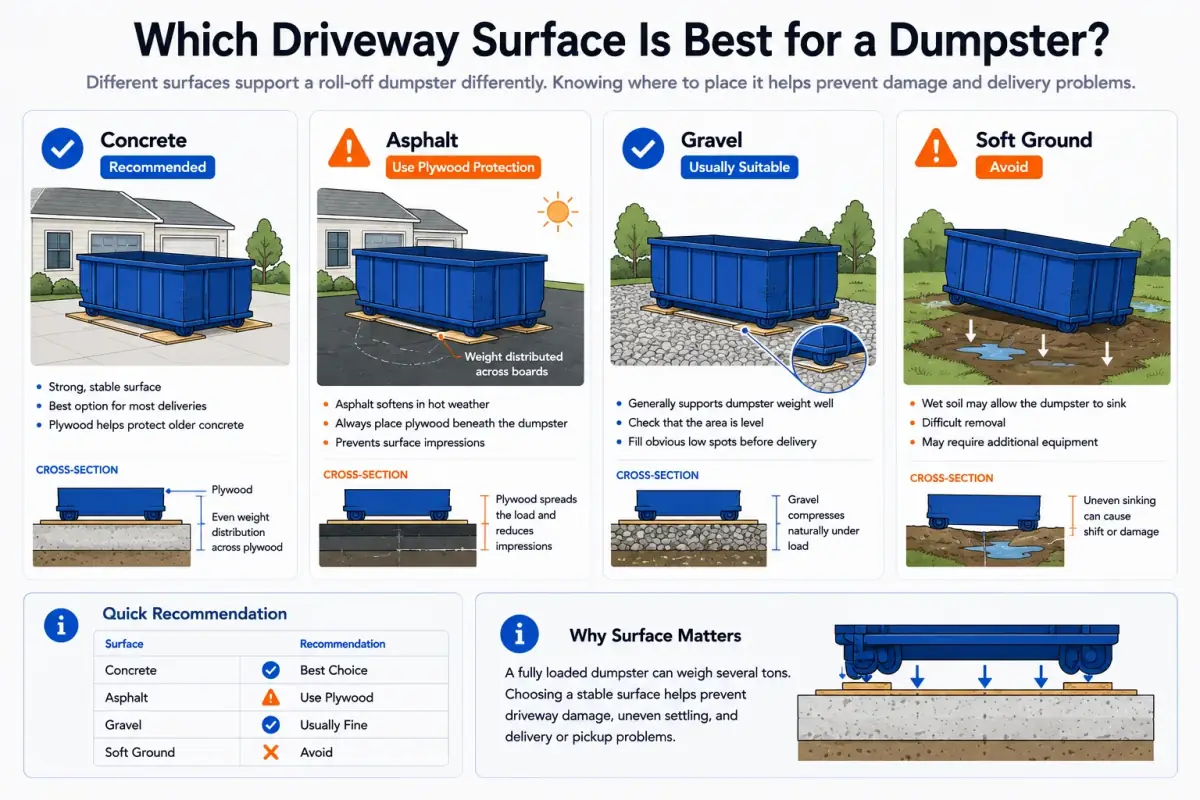
A loaded roll-off container weighs between 3 and 10 tons depending on the material inside. That load presses down through two steel skid points at the base of the container. Without a buffer, those skid points bear directly against your driveway surface for the entire rental period.
Concrete driveways in Longview typically handle container weight without visible damage if the concrete is in good condition and poured at least 4 inches thick. Older concrete slabs with existing cracks — common in mid-century neighborhoods in South Longview and around downtown — are at higher risk of those cracks propagating under load. Placing 3/4-inch plywood boards under the landing zone is inexpensive protection against a repair that costs far more.
Asphalt driveways present a different problem in East Texas summers. Asphalt surface temperatures in Longview regularly exceed 140°F on clear summer afternoons — hot enough to soften the asphalt binder significantly. A loaded container sitting on summer asphalt without a protective layer can leave impression marks at the skid contact points that do not recover when the asphalt cools. We place protective boards under the container as standard practice, but adding your own plywood sheets under the landing zone gives an extra buffer against the combined effect of East Texas heat and container weight.
Gravel and caliche driveways common in rural Gregg County and unincorporated areas south and east of Longview city limits generally work without surface damage — the loose material conforms to the container's weight rather than cracking. The concern with caliche is leveling: if the surface is uneven, the container may not seat flat, which can cause it to shift during the rental period. Fill any low spots in the landing zone before delivery if the surface has visible dips.
Soft or saturated ground should be avoided entirely. East Texas clay — particularly after a rainfall — can allow a loaded container to sink progressively over the rental period. If the container sinks unevenly, extraction requires equipment beyond the standard delivery truck, which adds cost and delays pickup. If your property has drainage issues or the ground is soft from recent rain, tell us at booking and we will discuss alternate placement options.
Move everything out of the placement area and the full 60-foot approach path the evening before delivery — not the morning of. The most consistent cause of failed deliveries in Gregg County is a vehicle left in the drop zone overnight that someone forgot to move before 8 a.m. When the truck arrives, the driver cannot wait while the spot is cleared. The route continues and the delivery is rescheduled, with a trip fee added to the invoice.
The cleared path includes the approach, not just the landing spot. A vehicle parked at the end of the driveway blocks the truck even if the placement area itself is open. Clear the full line of travel from the street to the container's final position.
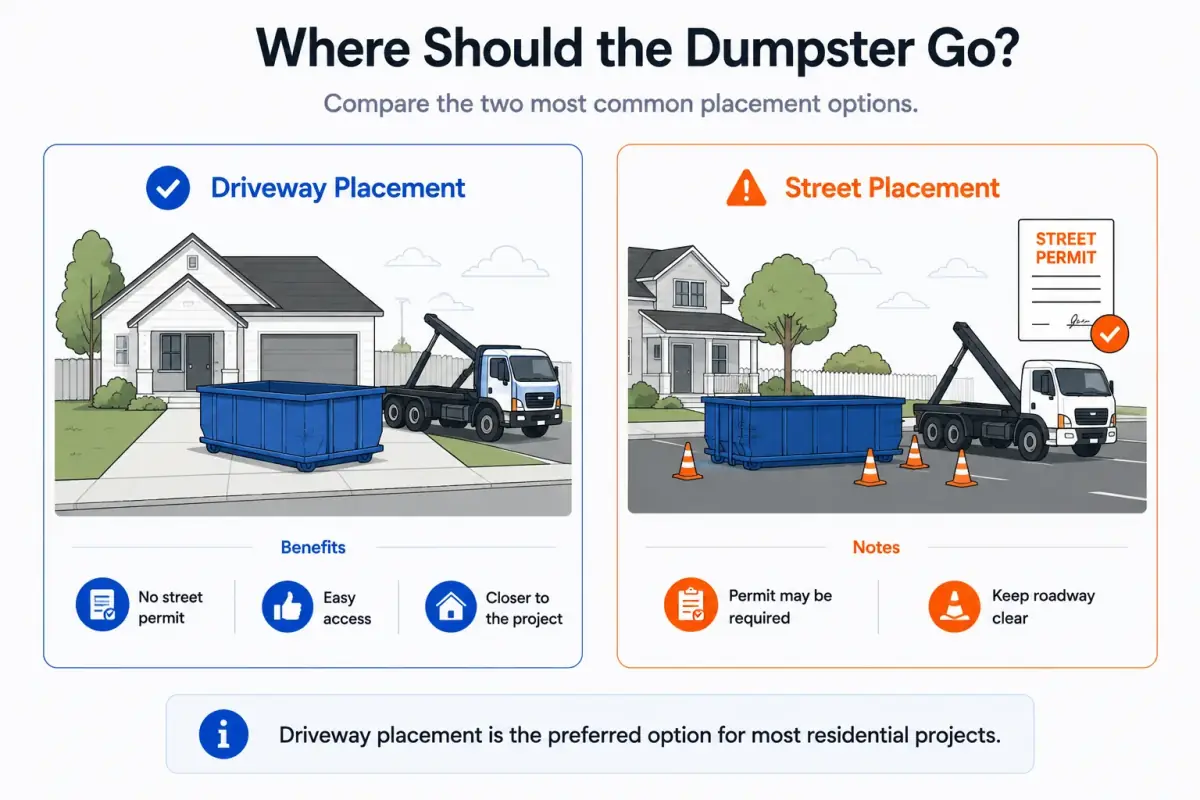
If the driveway is too narrow, too low-clearance, or too steep to accept a roll-off container, street placement is the standard alternative. It adds a permitting step but is routinely handled — particularly in older Longview neighborhoods with pre-1960s single-car driveways in areas near downtown, South Longview, and established blocks west of Loop 281.
Any roll-off container placed in a City of Longview public right-of-way — including the street lane, the shoulder, or the paved area between the curb and the sidewalk in front of your property — requires a permit from the City of Longview Public Works department. The permit process requires that the container be marked with reflective material visible to approaching vehicles at night. Plan for 48 to 72 hours of processing time before your delivery date — applying the morning of is not workable for next-day delivery.
In unincorporated Gregg County areas on FM roads and county roads outside Longview city limits, the requirements differ. Some rural routes have no formal permit process; others require coordination with the county road department. Call us with your address at booking and we will advise based on the specific location. We handle street placements across Gregg County and know which roads require advance coordination.
Several newer developments on the northwest side of Longview — and some established subdivisions with active HOAs — have deed restrictions that govern dumpster placement on the property or in the adjacent street. If your neighborhood has an HOA, review the deed restrictions or contact your HOA management before booking. A brief notice to immediate neighbors before the container arrives avoids most disputes about a roll-off sitting in the street for several days during a project.
No. As long as the drop zone is cleared and accessible, the driver completes the delivery without anyone present. Estate executors clearing a property between visits, property managers coordinating contractor work, and out-of-town homeowners managing a renovation remotely all use this routinely.
The driver calls or texts 30 to 60 minutes before arriving. If you want confirmation when the container has been placed, the driver can send a message before leaving the site — ask for this at booking. Delivery takes 10 to 15 minutes from the time the truck arrives at the property.
What matters is that the access information reaches the driver before departure from the yard — not via a note on your door on delivery morning. Gate codes, fence latches that require a specific technique, dogs that need to be put inside, and narrow entry points with a tight angle from the street are all details that need to be in the booking record. Your access notes are passed directly to the driver during route briefing. A last-minute text on the morning of delivery may not reach the driver before the truck is already en route.
A failed delivery — where the truck arrives but cannot complete the drop — results in a trip fee and resets the delivery timeline. The rescheduled delivery is typically the next available slot, which may be the following business day depending on route availability. For projects with crews scheduled to start the morning of container delivery, a one-day slip has downstream costs that exceed the trip fee by a significant margin.
The causes of failed deliveries follow a consistent pattern across Gregg County:
A two-minute conversation at booking describing your placement spot prevents most of these. If there is any uncertainty about whether your setup will work, describe it. We would rather spend five minutes working through the approach before booking than deal with a failed delivery and the downstream costs for everyone involved.
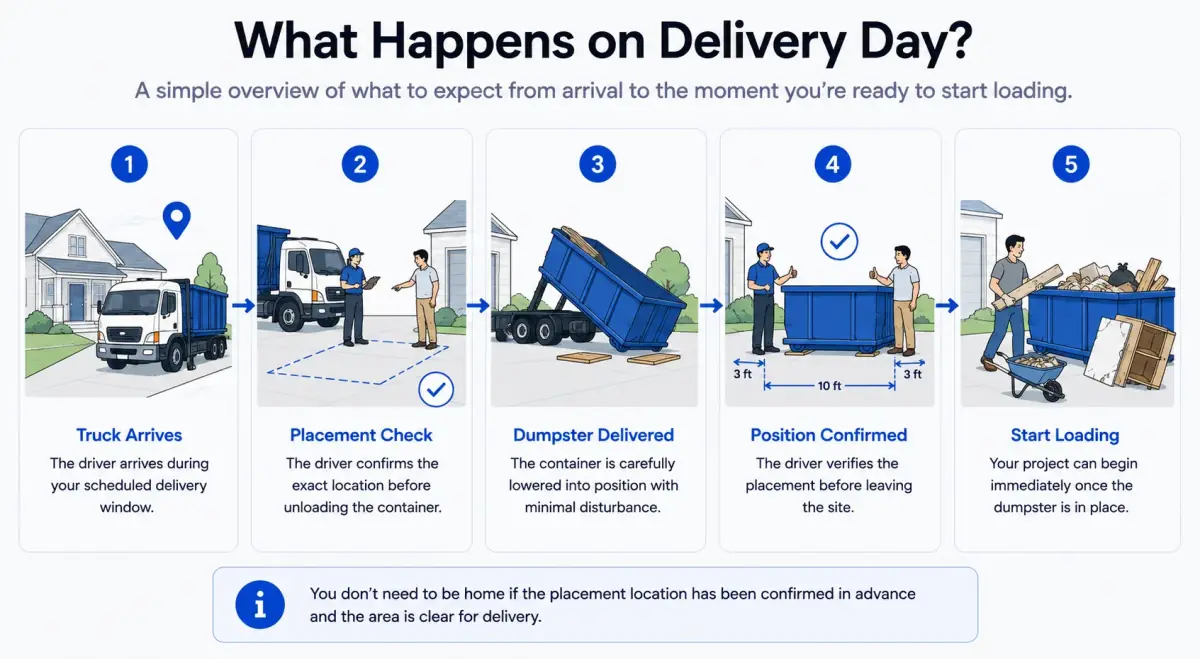
Most of the preparation happens the evening before, not the morning of.
These dumpster delivery tips for Longview, TX reduce failed deliveries to near zero — the causes are predictable and the fixes take less than fifteen minutes the night before. The dumpster placement tips for Longview, TX that prevent the most failures: confirm the 60-foot clearance length, measure any overhead obstructions along the approach path, clear all vehicles and obstacles the evening before, and communicate access details at the time of booking. Every failed delivery in Gregg County traces back to one of those four items, and all four are within the customer's control before the truck ever leaves the yard. Once delivery is sorted, review what can go in a dumpster so your load is ready when it lands.
No. As long as your placement spot is cleared and accessible, the driver can complete the delivery without you present. You will receive a call or text 30 to 60 minutes before arrival. Estate executors, property managers, and out-of-town homeowners handle this routinely — the only requirement is that gate codes and access complications are in the booking record before the truck departs, not communicated on delivery morning.
If the driver arrives and cannot safely complete the delivery — a blocked zone, overhead obstruction, locked gate, or clearance that does not meet the minimums — the delivery cannot proceed and a trip fee applies. The driver cannot wait on-site while the issue is resolved. The delivery is rescheduled for the next available window. Clearing the zone the night before and providing complete access information at booking are the only reliable ways to prevent this.
Yes. Any container placed in the City of Longview public right-of-way — including the street, shoulder, or paved area between the curb and sidewalk — requires a street placement permit from the City of Longview Public Works department. Allow 48 to 72 hours for permit processing before your delivery date. Containers must be marked with reflective material. For addresses in unincorporated Gregg County outside city limits, requirements vary — call us with the address and we will advise.
We place protective boards under the container as standard practice. For extra protection — especially on asphalt driveways in East Texas summer — lay 3/4-inch plywood sheets in the landing zone before delivery. Longview asphalt surface temperatures regularly exceed 140°F in summer, and a loaded container on softened asphalt can leave impression marks at the skid contact points that do not fully recover. Concrete driveways in good condition generally hold without visible damage.
No. Roll-off containers require the delivery truck to reposition them. You cannot move the container yourself, and it should not be dragged or pulled across any surface. If the placement needs to change after drop-off, call us to schedule a reposition — a service call fee applies. Getting the placement right at booking is worth a detailed conversation: tell us the exact spot and driveway configuration, and we will confirm whether it is workable before the truck leaves.
60 feet of clear length, 10.5 feet of width, and 25 feet of vertical clearance. These are hard constraints of the hook-lift equipment — not estimates or guidelines. In Gregg County, the most frequent clearance failures are loblolly pine canopies over residential driveways, utility lines running at 18 to 25 feet over streets, and low-profile carport overhangs. Walk the full approach path from the street to the placement zone and look up before you call.
Best for garage cleanouts, small bathroom renovations, or garden debris.
Starting at $325 / 7 Days
The industry standard for roofing, kitchen gutting, and large home clear-outs.
Starting at $450 / 7 Days
Engineered for major construction projects, site prep, or full estate cleanouts.
Starting at $650 / 7 Days
Serving Greater Longview
Longview, Kilgore, White Oak, Hallsville, Marshall and surrounding East Texas
Office Hours
Mon - Fri: 7:00 AM - 6:00 PM
Sat: 8:00 AM - 2:00 PM