
10 Yard
ResidentialBest for garage cleanouts, small bathroom renovations, or garden debris.
Starting at $325 / 7 Days
- 2 Tons Included
- Driveway Protection
- ~12 ft × 7.5 ft × 4 ft

Dumpster Rental 101
The extra charges that show up on any dumpster rental in Longview, TX invoice almost always trace back to two things: a load above the fill line and a prohibited item nobody pulled out first. Both are avoidable before the first bag goes in.
Knowing how to fill a dumpster correctly is the difference between a clean invoice and a stack of avoidable charges. Trip fees for overfilled loads, overage fees for weight limits crossed, contamination fees from a prohibited item found at the landfill — all avoidable at loading time. The same project, loaded with the right sequence and with prohibited items removed first, generates none of them. What follows is the loading logic that applies specifically to roll-off containers in Gregg County: the fill line rules the driver enforces, the weight math for the debris types most common in Longview renovation projects, and the TCEQ-grounded list of what cannot go in. A dumpster can be physically half empty but legally full the moment its included weight allowance is reached — and with the wrong debris type, that moment arrives well before the container looks full.
Roll-off containers have a top rail. Debris must stay level with or below that rail — nothing extending above it, and nothing that could shift above the line during transport. This is not a company policy; it is a legal requirement for hauling on Texas roads. A load extending above the rail requires a tarp-and-tie-down arrangement that hook-lift trucks are not equipped to provide.
When the driver arrives for pickup and the load is above the rail, the container stays. The route continues, pickup is rescheduled, and a trip fee is added to the invoice. Material needs to come out of the container until the load sits level with the top rail before the rescheduled pickup can proceed. On a project with a crew waiting for the empty container, a one-day delay from an overfill has downstream costs that exceed the trip fee.
What "level with the top rail" looks like in practice:
Check the fill line from the side of the container every few loads, not just at the end. A dumpster that looks level from the loading door often has a mound in the middle that is only visible from the side. Walk all four sides before calling for pickup — the angle you load from is the worst angle to judge the fill line from.
If your project involves concrete, shingles, or tile, confirm your weight allowance for those materials before loading begins. The visual fullness of the container is not a reliable indicator when the debris is dense — a container can be at its legal weight limit while still appearing less than half full. The weight limits guide covers this by debris type.
Most projects that end up needing a second container do so because the first container was loaded inefficiently — not because there was more debris than a single box could hold. The sequence below applies to mixed residential and renovation debris typical of Longview projects: kitchen and bath demolitions, cleanouts, roofing tear-offs with some interior debris, and whole-house estate clearances.
Ordering one size larger than you think you need is almost always cheaper than a second haul. A correctly loaded container of the right size usually handles what two poorly-loaded ones cannot.
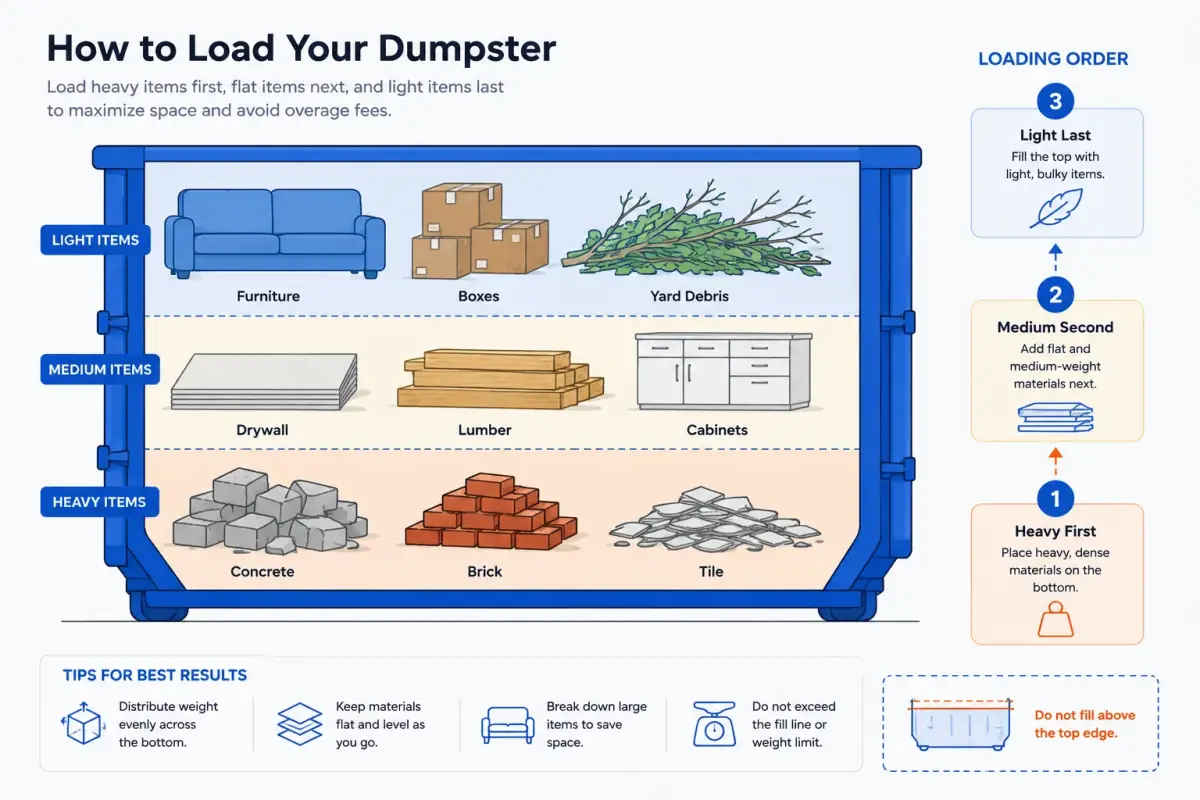
Concrete blocks, ceramic tile, brick, soil, and appliances go in first — laid flat on the container floor through the loading door. This creates a stable, level base and prevents lighter, bulkier materials from bridging over the dense items and wasting the space beneath.
The single most expensive loading mistake in a demolition project is putting light materials in first. Drywall and furniture loaded before the concrete means the heavy material has nowhere to seat flat — it ends up perched on top of voids, the weight distribution is uneven, and the container appears full while the floor never got properly loaded. Save the floor for what belongs there.
A kitchen cabinet unit installed as a whole takes three to four times the volume of the same cabinet disassembled. Hollow-core doors, cabinet carcasses, bed frames, and sectional sofa pieces should all be broken apart or cut before loading. A reciprocating saw on a project site recovers its cost in reduced dumpster load counts on jobs with significant millwork or framing.
Branches and brush are the most common source of wasted volume in Longview yard cleanouts. Loose brush piled randomly uses 40 to 50 percent more volume than the same material cut to 4-foot lengths and stacked horizontally. If you are managing a crew clearing a property, designate someone to cut brush before it goes in — it is faster than ordering a second container.
After the large structural pieces are down and any initial heavy layer is set, fill the visible gaps with drywall fragments, concrete chips, gravel, insulation batts, and small bagged material. The goal is eliminating air pockets. Voids between large pieces are the primary reason containers appear visually full while still being well under the weight limit — a situation where you are paying for volume capacity you never actually used.
Carpet rolls, foam padding, insulation batts, and plastic-bagged material go on top of the load, placed last. These materials are pliable — they conform to the surface of what is already loaded and naturally fill the remaining gaps rather than creating voids under them. Loading foam or carpet first inverts this: lighter material bridges between harder items, leaving hollow pockets that waste the useful volume underneath.
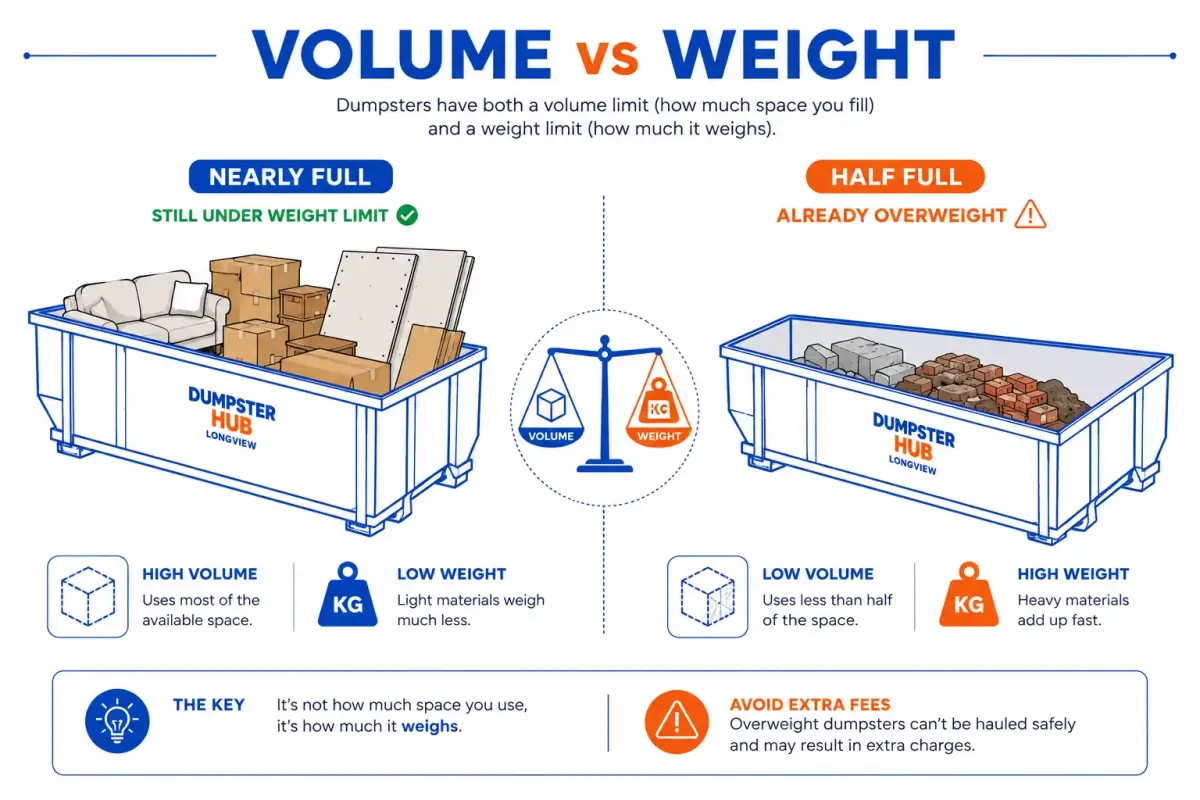
Roll-off containers have two independent limits: cubic yard capacity (volume) and included tonnage (weight). A project's debris type determines which limit you reach first — and the cost implications are different depending on which one it is. The most common surprise for first-time renters is discovering a container is legally overweight while still visually less than half full, because the debris type — not the volume — set the ceiling.
Household furniture, lumber, drywall, yard waste, carpet, and mattresses fill cubic yards quickly while staying well under weight allowances. A cleanout of a 3-bedroom house, a bathroom renovation, or a full-fence tear-down generates debris that will fill a 20-yard container before it approaches a 3-ton weight limit. For these projects, container size selection matters more than weight management.
Concrete, brick, masonry, soil, gravel, and roofing shingles reach the weight limit while the container is visually well under full. The practical numbers:
For projects with significant concrete demolition, full roof tear-offs, or masonry work, the standard recommendation is a dedicated 10-yard container sized for the weight — not the volume — per phase of the heavy demolition. Mixing dense masonry debris with lighter household or renovation debris in a single load routinely produces an overage fee on what looks like a container that is barely half full. The weight limit guide has the specific per-material numbers.
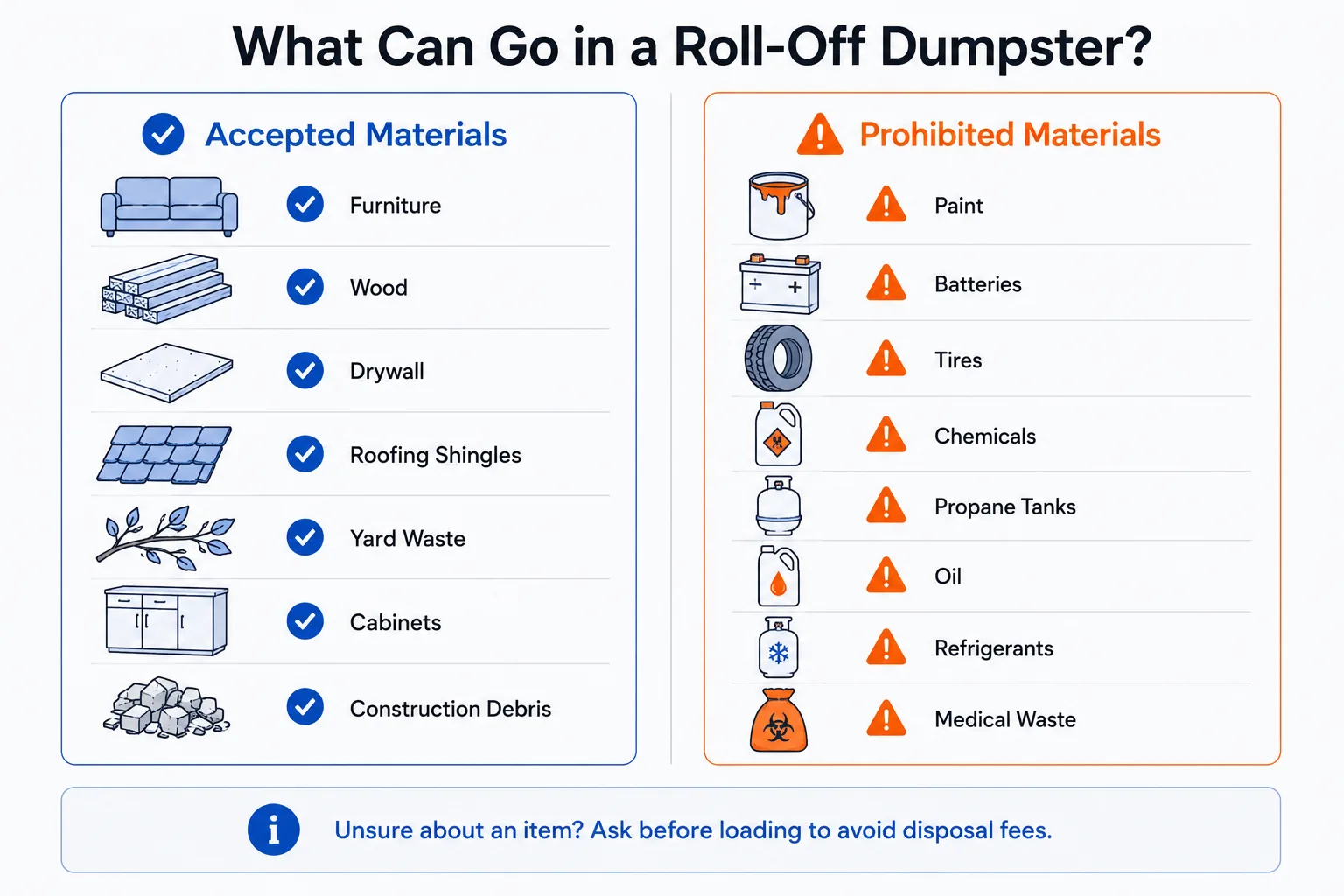
Texas Commission on Environmental Quality (TCEQ) regulations and the landfill’s acceptance rules determine what can and cannot go in a roll-off container. A prohibited item found at the landfill after pickup generates contamination fees and can result in the entire load being classified as contaminated and rejected — triggering additional disposal costs that are passed back to the customer. Pull these items out of the debris pile before the first load goes in.
If you are clearing an older property in South Longview, near downtown, or along the streets that predate the 1980s and are not certain what materials you are looking at — do not load them first and find out later. A single asbestos test costs a fraction of what a contaminated load rejected at the landfill costs, plus the licensed disposal that follows. Call us before loading and we can advise on what to flag for testing.
East Texas averages 46 to 50 inches of rainfall per year — more than Seattle — concentrated in spring and early summer and again in fall. A multi-day project in Gregg County will almost certainly intersect with at least one rain event. Open-top roll-off containers collect that water, and the water adds to the gross weight measured at the landfill after pickup.
The added weight depends on what is in the container and how porous it is. Debris that absorbs water — drywall, lumber, yard waste, cardboard, insulation — retains significantly more than concrete or tile. A half-inch drywall sheet weighs approximately 55 pounds dry and absorbs 30 to 40 percent of its weight in water; a full bathroom or kitchen demo's worth of drywall left uncovered through an East Texas overnight rain can add several hundred pounds before a single new piece goes in the next morning. A 20-yard container with a full load of absorbent household debris that sits through a 3-inch East Texas rain event can gain 800 to 1,500 pounds of water weight. If that rain pushes the total past the included tonnage, the overage is billed at the per-ton rate in the rental agreement — the same rate as any other weight overage.
Tarp the container when you are not actively loading. A standard poly tarp secured with bungee cords across the top rail keeps rain out and serves a second purpose: it prevents opportunistic dumping from neighbors or passersby who see an open container as a convenient disposal option. If the container is sitting in a visible, accessible location — street-side or at the front of a property — a tarp is worth the few minutes it takes to secure it each evening.
Cover materials on the project site as well as the container. Partially demolished drywall left on a project site during an overnight rain absorbs water and arrives in the container saturated — heavier and more likely to turn to slurry. Cover piles on the site, not just the container opening, before a forecast storm.
A standard rental in Gregg County typically runs 7 days. If a project is moving faster than expected, call to schedule an early pickup — there is no benefit to keeping a full container on-site until the rental period expires. If a project is running behind, call before the period ends to add days at the daily rate in your agreement. The worse path is waiting until the container is overdue and having a pickup forced on a day that disrupts the project. Extensions are straightforward — the complication only comes from not requesting one until after the rental has already lapsed.
A swap — where we pick up the full container and return an empty one to the same spot — is the right call on multi-phase projects that generate more debris than a single container can hold in one load cycle. It is more efficient than booking a second full rental from scratch because the placement location is already established, access details are in the system, and the driver knows the property.
Request a swap as soon as it is clear the container will fill before the project is done — not when it is already overloaded. A container at or above the fill line cannot be transported. Material needs to come out before the pickup can proceed, which defeats the purpose. The moment the container reaches approximately three-quarters capacity and more debris is still coming, call and schedule the swap so it is queued for when the container fills rather than after.
Run through this before the first item goes in and again before calling for pickup.
Knowing how to fill a dumpster correctly — heavy material first, bulky items broken down and layered tightly, prohibited items removed before the container arrives — keeps the invoice at the base rate from start to finish. Understanding how to properly fill a dumpster also means respecting the fill line before loading begins, not discovering the container is above the rail when the driver arrives for pickup. The fifteen minutes spent on loading sequence and weight planning at the start of the project eliminates the most common extra charges on a Gregg County dumpster invoice: trip fees, overage charges, and contamination fees.
The driver cannot transport the container. A load extending above the top rail cannot be moved on a Texas road without a tarp-and-tie-down arrangement that hook-lift trucks do not carry. The driver will note the overfill, the route continues, and pickup is rescheduled with a trip fee added to the invoice. Material needs to come out of the container until the load sits level with the rail before the rescheduled pickup can proceed.
You can, but weight is the constraint. Concrete runs approximately 4,000 pounds per cubic yard. A container that is only 30 to 40 percent full of concrete may already be at or near its tonnage allowance — the rest of the space is not usable for weight reasons, even though it is visually open. A concrete-dedicated container sized for the weight rather than the volume is usually more cost-effective than mixing. Call with the estimated volume and we will advise.
Across Gregg County, the most frequent violations are old pesticide and herbicide containers from rural properties, refrigerators and window AC units with intact Freon circuits, tires, and televisions classified as e-waste. Pre-1980 construction debris from established Longview neighborhoods — vinyl floor tiles, duct insulation, old roofing shingles — can also contain asbestos and require testing before disposal. Pull these items before loading begins, not after the container is being picked up.
Yes. The container is weighed at Pine Hill Landfill after pickup, and water absorbed into debris during a rain event counts toward the gross weight. A 20-yard container with absorbent materials — drywall, lumber, yard waste — can gain 800 to 1,500 pounds during a significant East Texas rain. If that additional weight pushes the total past the included tonnage, the overage is billed at the per-ton rate in the rental agreement. Tarping the container between loading sessions is the practical prevention.
A swap is when we pick up the full container and return an empty one to the same location — usually same or next business day in Gregg County. It is the right call when a single container will not hold the full project debris and you need continuous removal without re-booking from scratch. Request it when the container is about three-quarters full, not after it is already overloaded. A container at or above the fill line cannot be transported to swap — material has to come out first.
A single-layer tear-off on a 2,000-square-foot roof produces 20 to 25 squares: 4,000 to 6,000 pounds for 3-tab shingles, or 7,000 to 10,000 pounds for architectural shingles — the standard in Longview reroofing since the late 1990s. A second layer doubles that. The standard sizing for a roofing dumpster is a dedicated 10-yard container per shingle-layer phase. Tell us the roof square footage and number of layers when you call and we will size it correctly.
Best for garage cleanouts, small bathroom renovations, or garden debris.
Starting at $325 / 7 Days
The industry standard for roofing, kitchen gutting, and large home clear-outs.
Starting at $450 / 7 Days
Engineered for major construction projects, site prep, or full estate cleanouts.
Starting at $650 / 7 Days
Serving Greater Longview
Longview, Kilgore, White Oak, Hallsville, Marshall and surrounding East Texas
Office Hours
Mon - Fri: 7:00 AM - 6:00 PM
Sat: 8:00 AM - 2:00 PM