
10 Yard
ResidentialBest for garage cleanouts, small bathroom renovations, or garden debris.
Starting at $325 / 7 Days
- 2 Tons Included
- Driveway Protection
- ~12 ft × 7.5 ft × 4 ft
Dumpster Rental 101
The base rate covers the container, delivery, pickup, and included tonnage. The surprises on a final invoice almost always trace back to weight overages, extended rental periods, and debris types that hit the tonnage limit before the container looks full.
Want to understand the full booking and delivery process? See how our process works from first call to final invoice, or learn more about us and how we operate as a local hauler.
Dumpster rental prices in Longview, TX are built differently than what national platforms quote. The number on a national platform and the number on a Longview invoice after pickup differ for a reason: the platform uses national average data. A Gregg County delivery means a specific haul distance to the landfill, a specific tipping fee structure under Texas disposal regulations, and a fuel surcharge tied to East Texas diesel prices — none of which is averaged into a national quote. Understanding what each line item represents is the fastest way to know whether a quote is genuinely competitive or simply showing you the cheapest number before the add-ons appear. The full cost of the dumpster rental Longview homeowners and contractors book has four components: the base container rate, the included tonnage for the debris type, the rental period, and the contingency charges that only appear when something goes wrong at loading or pickup.
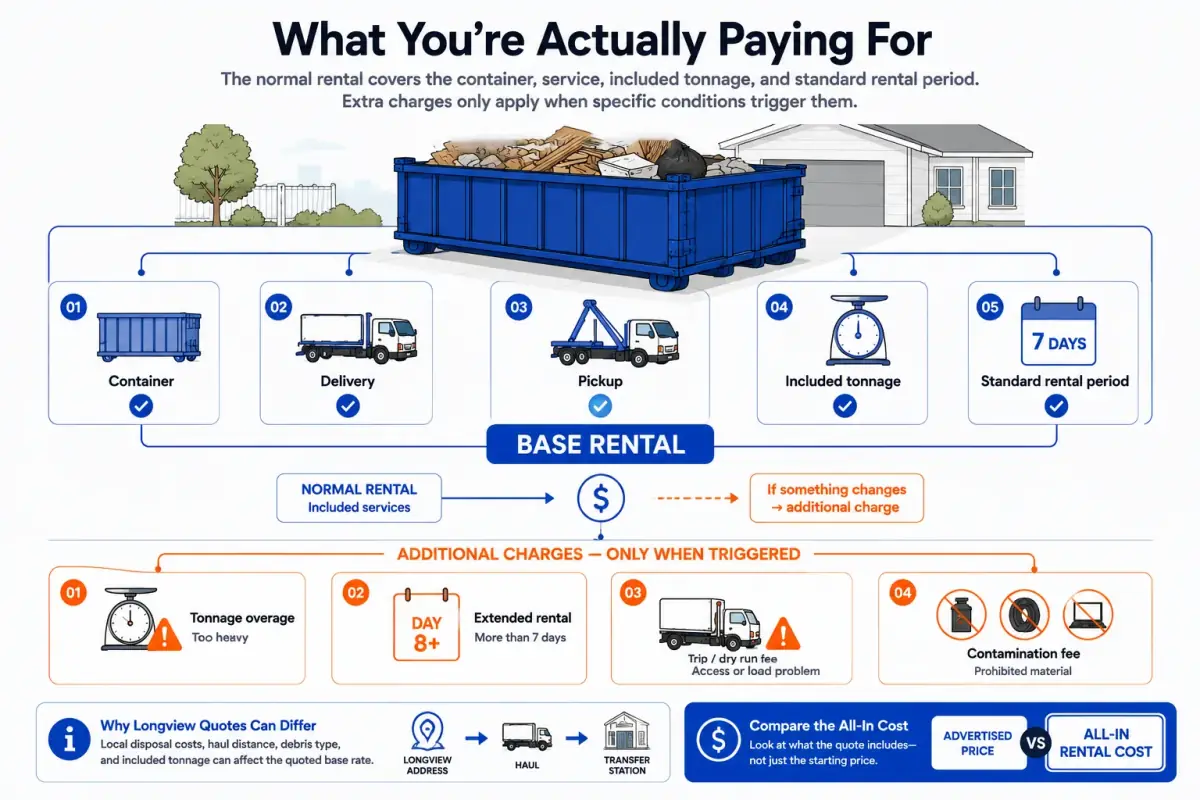
The base rate covers container delivery to your Longview address, the 7-day rental period, included tonnage for the debris type confirmed at booking, and final pickup and disposal. The rate does not change based on what neighborhood in Gregg County you are in — there is no distance surcharge within the standard service area. What changes between the three container sizes is the volume capacity, the weight allowance, and the type of project each is sized for.
The 10-yard container is approximately 12 feet long, 8 feet wide, and 3.5 feet tall (outside dimensions). It holds roughly the equivalent of three pickup truck loads of debris. The 2-ton weight allowance makes it the correct size for weight-limited debris — primarily roofing shingles, concrete demolition, and tile — where the tonnage ceiling is reached well before the container appears full. For a heavier roofing or concrete job, the 20-yard adds a full extra ton of included weight, which is often cheaper than paying overage on a 10-yard.
Best-fit projects: single-layer roof tear-offs, bathroom tile demolition, small concrete slab removal, garage cleanouts, shed teardowns, and small landscaping debris piles.
The 20-yard container is approximately 22 feet long, 8 feet wide, and 4.5 feet tall (outside dimensions) — the most frequently rented size in Gregg County. The 3-ton weight allowance handles mixed residential and renovation debris, where the volume ceiling is reached before the tonnage limit. A kitchen gut, a multi-room renovation, or a home cleanout that involves furniture, drywall, lumber, and carpet will fill this container to its volume limit without approaching the weight ceiling.
Best-fit projects: kitchen and bathroom renovations, multi-room flooring tear-outs, estate cleanouts, fence demolition, mid-size landscaping projects, and mixed renovation debris with some light framing.
The 30-yard container is approximately 22 feet long, 8 feet wide, and 6 feet tall (outside dimensions) — the largest standard residential roll-off in the Longview market. The 4-ton weight allowance is appropriate for large-volume, mixed-debris projects where the debris is not exclusively heavy. A whole-house renovation, a commercial construction site, or a full-property clearance with multiple structure teardowns typically requires this size.
Best-fit projects: major home additions and renovations, full-structure teardowns, large multi-phase commercial cleanouts, and projects with a dedicated site management crew running continuous debris disposal.
The critical selection rule: for light, bulky debris, choose by volume (cubic yards). For dense debris — concrete, masonry, roofing — choose by weight. Ordering the wrong axis costs more than the size upgrade would have. The fill guide covers weight limits by debris type in detail.
A dumpster rental invoice is not arbitrary. Every dollar in the rate traces back to a real operating cost. Understanding those costs is useful when comparing quotes, because the cheapest number upfront is not always the cheapest total — a low base rate with a high per-ton overage fee can produce a larger final invoice on a heavy debris project than a slightly higher flat rate with a more generous tonnage allowance.
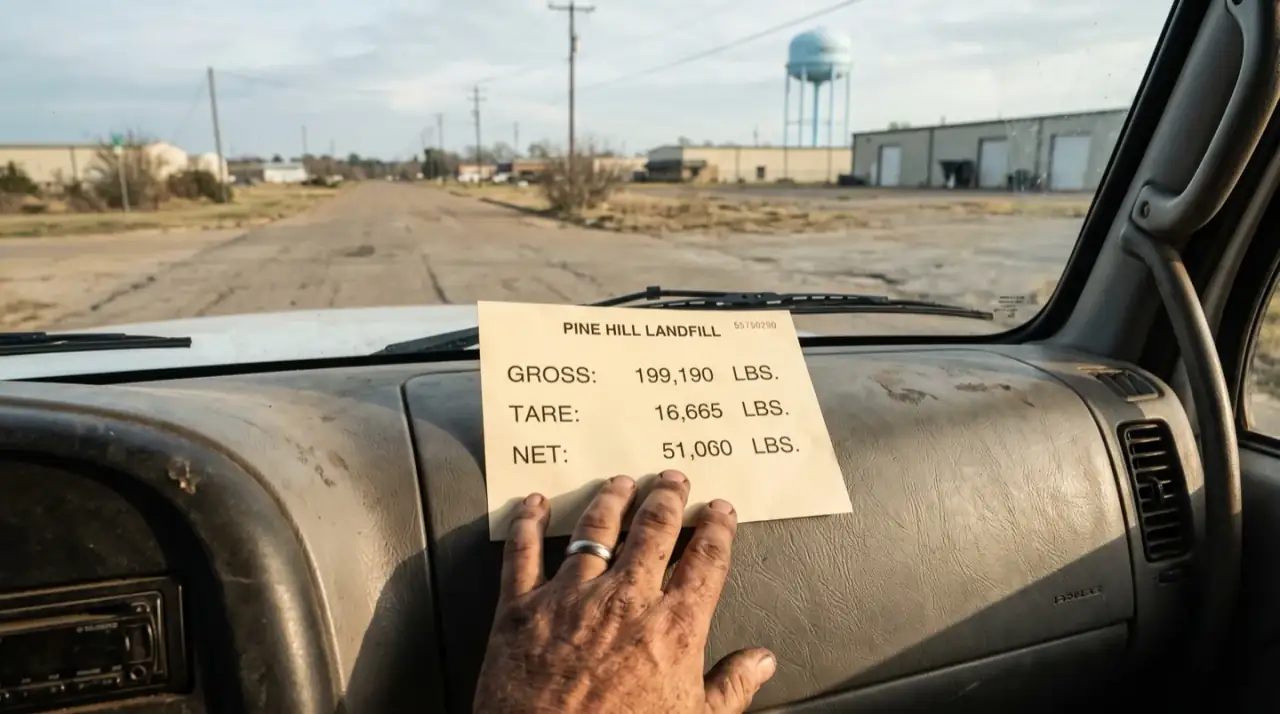
Every load from a Gregg County roll-off ends at Pine Hill Landfill, which charges a per-ton tipping fee for accepting the debris. This is not a profit line — it is a pass-through cost built into the base rate. Texas Commission on Environmental Quality (TCEQ) regulations govern what debris streams each facility can accept. Construction and demolition debris, residential household waste, and clean fill have different fee structures at licensed disposal facilities, and that difference is one of the reasons debris type affects pricing: what you load determines where it goes and what the disposal fee is.
The round-trip haul distance — from the depot to your address, and from your address to the landfill — is a direct cost component. Longview's location in East Texas means haul distances that are longer than metro markets like Dallas or Houston, where dense competition and shorter routes between depots and transfer stations push base rates down. East Texas haul distances are real operating costs; they do not disappear because a national platform shows a lower average.
Hook-lift trucks run on diesel. East Texas diesel prices track the Gulf Coast PADD 3 benchmark published weekly by the U.S. Energy Information Administration. When regional diesel prices move significantly, fuel surcharges adjust accordingly. This line item is transparently disclosed in the rental agreement. It is not a hidden fee — but it is one reason a quote pulled six months ago may not match a current quote exactly.
Larger containers cost more because they carry more volume, require larger trucks for transport, and generate larger disposal loads at the landfill. The tonnage allowance attached to each size reflects what that container size realistically accepts on a standard project. Debris that consistently generates overages on a given container size is a signal that the container was undersized for that project type — not that the overage rate is excessive.
The standard 7-day rental period covers most residential projects from delivery to pickup. Projects that extend beyond the rental period generate a per-day extension charge, applied from day 8 forward. Calling to extend before the period expires is a simple, low-cost adjustment. Waiting until after the rental has lapsed can trigger a re-delivery fee if the driver needs to make an unscheduled trip. The rental period extension is disclosed in the rental agreement — know the daily rate before the project starts.
Every additional charge on a dumpster invoice has a root cause that was avoidable at some earlier point in the project. None of them are punitive in design — they reflect a real cost that was generated when the rental did not go as planned. The fastest way to keep the invoice at the base rate is to understand what triggers each one.
The most common additional charge in Gregg County dumpster rentals. The container is weighed at Pine Hill Landfill after pickup. Any weight above the included tonnage is billed at $65 per ton, the overage rate in the rental agreement. Overage fees most commonly appear on roofing projects and concrete demolition — debris types where the weight limit is reached while the container still looks visually under-full. The prevention is describing the debris type and estimated volume at booking and confirming that the included tonnage covers it. If there is any doubt about the weight, the more cost-effective path is to upgrade the tonnage allowance at booking rather than pay the per-ton overage rate after pickup.
If the driver arrives for pickup and the container cannot be transported — because the load extends above the fill line, because the truck cannot access the container, or because a prohibited item is visible in the load — the driver will not attempt the pickup. A trip fee is applied and pickup is rescheduled. The project stalls until material is removed from the container or the access issue is cleared. On a job site with a crew working against a deadline, a failed pickup has downstream costs beyond the trip fee itself. Check the fill line from all four sides before calling for pickup, and confirm the approach path is clear — 60 feet of length, 10.5 feet of width, 25 feet of vertical clearance.
The per-day rate that applies after the standard 7-day rental period. The rate is in the rental agreement. Call before the period ends to request an extension — this is a simple one-call process and the daily rate applies from the extension date. Waiting until after the period lapses creates the possibility of an unscheduled pickup or re-delivery fee depending on the gap. If you know at the start of a project that it will run longer than 7 days, ask about an extended rental at booking — the rate is typically lower than adding days after the fact.
A prohibited item found at the landfill after pickup generates a contamination fee. Depending on the item — hazardous waste, an unprocessed Freon appliance, asbestos-containing material — the entire load can be classified as contaminated and rejected, with licensed disposal arranged separately at the customer's cost. The prevention is pulling prohibited items from the debris pile before the first load goes in. The full list of what cannot go in a Gregg County roll-off is covered in the accepted and prohibited items guide. If you have a specific item you are unsure about, call before loading — not after pickup.
If the driver attempts delivery and cannot place the container because the space is insufficient, a low-clearance obstacle blocks the approach, or the gate or access point is locked — the driver notes the failed attempt and returns to the depot. A dry run fee applies. The delivery preparation guide covers the space and clearance requirements in detail. Walking the intended placement area before the scheduled delivery date and confirming the approach path is clear eliminates this charge entirely.
A homeowner doing research on dumpster rental costs before calling will encounter national platforms — aggregator sites that connect customers with haulers across the country by taking a margin on each transaction. The quotes these platforms generate are averages, and the averages are pulled from markets that look nothing like East Texas. The gap between a national platform estimate and a Gregg County quote is not markup — it is the difference between national data and local cost structure.
The Dallas–Fort Worth metro has dense competition among dozens of haulers, multiple transfer stations and C&D landfills within short haul distances, and fuel economics driven by high fleet volume. That market produces aggressively competitive rates that drive down the national average. Longview is a smaller market with fewer competing haulers, longer average haul distances to qualifying disposal facilities, and a cost structure that reflects those realities. A quote built on DFW economics and applied to a Gregg County project is structurally wrong before the debris type is even considered.
East Texas landfills set their own tipping fees. Those fees are not the same as fees in Houston or Austin. The Gregg County area rate structure is specific — it reflects the cost of operating and maintaining the facilities that serve this region. Every Longview dumpster rental includes a Gregg County tipping fee in the base rate. A national platform quote that does not know which facility your debris is going to cannot price that correctly.
For context on where Longview sits regionally: dumpster rental rates in Tyler, TX (35 miles west) and Shreveport, LA (75 miles east) are comparable to Longview pricing because all three markets share similar East Texas / Ark-La-Tex cost structures — longer hauls, lower competition density, and similar landfill fee structures than the large Texas metros. If a national platform shows you a rate that looks significantly lower than what Longview haulers quote, it is almost certainly pulling from a DFW or Houston average. Ask specifically about the Gregg County all-in rate and whether the quote includes delivery, pickup, tonnage, and disposal — not just the container.
The right container for a project is the one that matches both the volume and the weight of the specific debris type. The following breakdowns are based on common project types in Gregg County — using the base rates and typical tonnage outcomes for each.
The standard setup for a Longview roofing project is a 10-yard container ($325) dedicated to the shingle tear-off, with a swap or second container if a second layer or large square footage pushes the weight beyond the first container's allowance. A single-layer architectural shingle tear-off on a 2,000-square-foot roof produces 7,000 to 10,000 pounds — which fills a 10-yard to its weight limit while it looks visually less than half full. Loading roofing debris into a 20-yard container ($450) does not add weight capacity — the tonnage ceiling is the same or similar; it only adds volume the shingles do not need. The most cost-effective roofing setup is a correctly sized 10-yard container per phase of the tear-off.
Total cost range for most Longview single-family re-roofing: $325 to $650 depending on shingle layers and roof square footage.
A kitchen gut — cabinets, tile, drywall, countertop — or a full bathroom tear-out generates mixed debris that is light enough to stay under the tonnage limit while filling significant volume. A 20-yard container ($450) handles most single-kitchen or single-bathroom renovations in the standard Longview house footprint (1,400 to 2,400 square feet). A kitchen plus a bathroom or two bathroom remodels simultaneously may require a 20-yard with a swap or a single 30-yard depending on the scope.
Total cost range: $450 for most single-room renovations; $650 to $900 for multi-room combined scope with a swap.
A whole-house cleanout or estate clearance in Gregg County spans furniture, clothing, appliances, yard debris, and light structural material. Volume drives the container choice — the debris is rarely heavy enough to hit a tonnage ceiling. A 20-yard container ($450) covers most 3-bedroom Longview house cleanouts when the loading is done efficiently. A larger property, outbuildings, or a heavily accumulated estate typically requires a 30-yard ($650) or a 20-yard with a swap. Extended rental periods are common on estate cleanouts — factor in the daily rate if the project will run longer than 7 days.
Concrete demolition — driveways, patios, slabs, retaining walls — is the most weight-intensive debris type in Longview residential work. A cubic yard of poured concrete weighs approximately 4,000 pounds. A 10-yard container dedicated to concrete can reach its weight limit with roughly 3 to 4 cubic yards of material — while appearing less than half full. The calculation is: estimate the cubic yardage of concrete to be removed, multiply by 4,000 pounds, then match that weight against the tonnage allowance. Multiple containers or a swap are the right setup for any concrete project above a small patio or sidewalk section. Never mix large concrete volumes with lighter household debris if the concrete volume is significant — the weight cross-purposes the container size selection for both debris streams.
A commercial construction site or large renovation project generating continuous debris typically benefits from a 30-yard container ($650) with a swap arrangement rather than multiple sequential smaller containers. The swap model — pickup full, deliver empty to the same spot — keeps the site running without re-booking logistics. For construction sites that generate debris across multiple phases (framing, drywall, finish), a standing arrangement is more cost-effective than individual bookings. Call to discuss volume and timeline for an accurate estimate for multi-phase commercial scope.
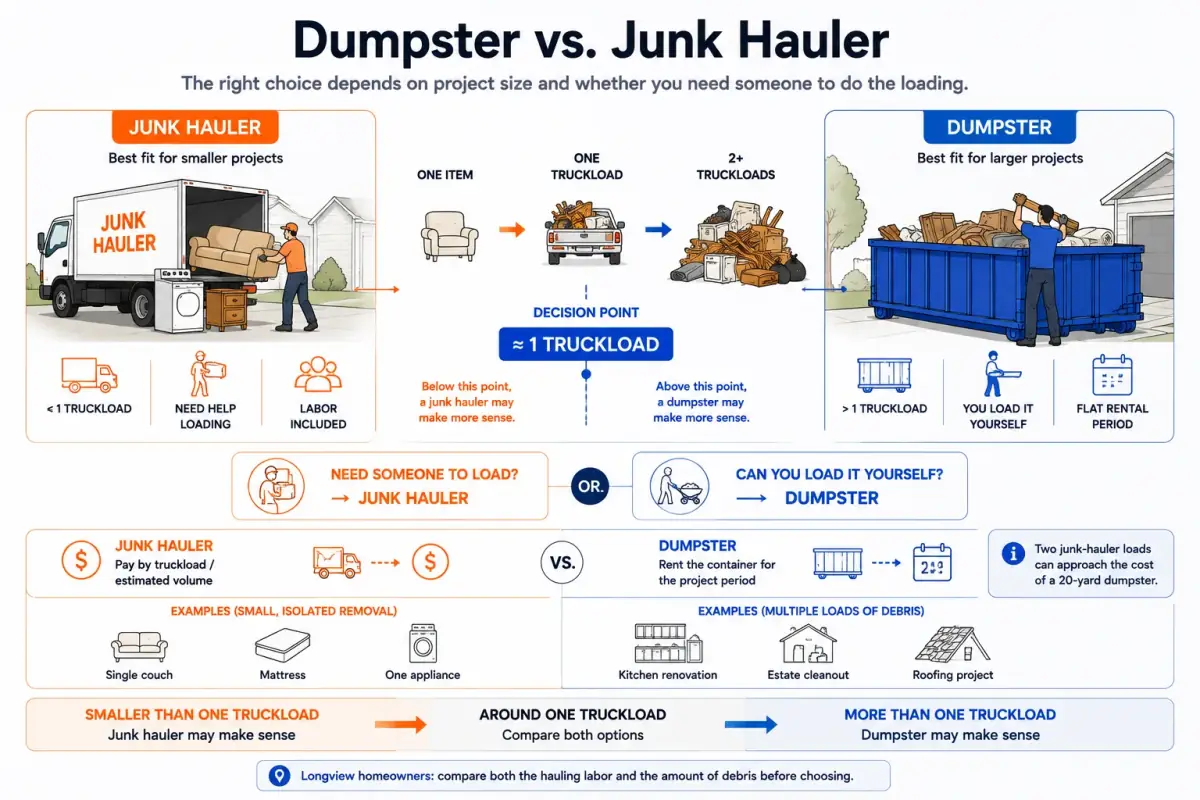
The default assumption for many Longview homeowners is that hiring a junk removal service is the convenient option and that renting a dumpster requires more effort. The cost reality reverses that assumption on most projects that generate more than one truck load of debris. The decision point is the project size and whether the customer can do the loading themselves.
A junk hauler in the Longview market charges by the truck load or by estimated volume — typically between $150 and $400 per load depending on the hauler and the debris type. Two loads from a junk hauler at the midrange rate ($225 to $300 per load) equals $450 to $600 before the second load is even fully priced. A 20-yard dumpster at $450 for 7 days, loaded at your own pace, covers the same project volume at a flat rate with no per-load premium.
The dumpster advantage grows with project scale. A multi-room renovation, a full estate clearance, or a roofing project that would require three or four junk hauler loads generates a cost differential that is significant — in the dumpster's favor. The practical math: any project that would require more than one junk hauler truck load is almost certainly cheaper with a dumpster rental when the customer can do the loading.
A junk hauler's value is labor — they load for you. If the customer cannot do any of the loading (elderly homeowner, medical limitation, no available help), the labor cost is legitimate and the per-load premium is the cost of that service. A single couch, mattress, or appliance that needs to be removed without any other debris is also a better fit for a junk hauler. For that volume, the minimum charge on a dumpster rental exceeds what a single-item haul costs.
The line between the two options is approximately one full truck load. Below that: junk hauler. Above that: dumpster rental. The threshold shifts downward if the customer has labor available to load and upward if none is available.
Every additional charge on a dumpster invoice is avoidable. The steps below eliminate the four most common add-ons — tonnage overages, trip fees, extended rental charges, and contamination fees — before they appear.
The most common sizing mistake in Longview is choosing a container by visual volume without accounting for debris weight. For light, bulky materials, size by cubic yards. For dense materials — roofing, concrete, tile, soil — size by tonnage. A 10-yard container at $325 with 2 tons included covers a small single-layer roof of about 15 squares or less. A 20-yard container at $450 with 3 tons included covers most single-layer 3-tab roofs up to about 25 squares, and the 30-yard at $650 with 4 tons included covers about 35 squares. Describe the debris type at booking; we will confirm the right tonnage allowance before the container is delivered.
Walk the full debris pile and pull prohibited items — hazardous waste, Freon appliances, tires, batteries, e-waste, and any suspected pre-1980 asbestos material — before the first bag goes in. A contaminated load discovered at the landfill generates a fee that exceeds the cost of the entire rental. The accepted and prohibited items guide has the full list. If you are unsure about a specific material, call before loading.
A load that extends above the top rail cannot be transported on a Texas road. Walk all four sides of the container — not just the loading door end — before calling for pickup. The angle you load from is the worst angle to judge the fill line. A mound in the center of the container that is invisible from the loading door is visible from the side. Check it. A trip fee on a failed pickup is avoidable by a 60-second walk-around. The fill line rules and loading sequence guide covers the specific measurements by container size.
A delivery that fails because of a blocked access point generates a dry run fee. A pickup that fails for the same reason generates a trip fee. The delivery preparation guide covers the required clearances: 60 feet of clear length, 10.5 feet of width, 25 feet of vertical clearance. If there are low-hanging branches, parked vehicles, or a gated entry, address them before the driver arrives — not after the attempt is already on record.
Call before day 7 if the project is running behind. A one-call extension at the daily rate is a routine, low-cost adjustment. A lapsed rental that triggers a forced pickup or re-delivery is avoidable by a single proactive call. If the project start date is uncertain, mention that at booking — we can advise on the right rental period to request from the beginning.
Dumpster rental prices in Longview, TX are built from four components: the container rate, the included tonnage for the debris type confirmed at booking, the rental period, and the contingency charges that only appear when something goes wrong at loading or pickup. How much does dumpster rental cost in Longview TX when everything goes as planned? The base rate covers delivery, a seven-day rental period, the included weight allowance, and final pickup — no extra charges unless the load runs over weight or the rental period extends. Call for a current quote specific to your project, debris type, and delivery location in Gregg County, contact us online, or browse our frequently asked questions.
National dumpster rental platforms display average rates drawn from national data — not Gregg County tipping fees, East Texas haul distances, or local fuel surcharges. A quote generated by a national platform for Longview is typically built on pricing from a much larger, more competitive market like Dallas or Houston. Our rates are built on the actual landfill tipping fees, disposal costs, and route distances that apply to Gregg County deliveries. Ask any quote provider for the all-in rate that includes delivery, pickup, tonnage, and disposal — not just the container.
The container is weighed at Pine Hill Landfill after pickup. Any weight above the included tonnage is billed at the per-ton overage rate in your rental agreement. Overage fees on roofing and concrete loads are the most common source of invoice surprises. Tell us your debris type and estimated volume at booking and we will confirm the right container and tonnage allowance to avoid them.
The base rate covers container delivery, the 7-day rental period, included tonnage, pickup, and disposal. Additional charges that can appear — but only if something goes wrong — are: tonnage overage fees if the load exceeds the included weight, per-day extended rental charges after day 7, a trip fee if pickup cannot be completed due to an overfill or blocked access, and a contamination fee if a prohibited item is found at the landfill. All four are avoidable with the right container choice and a clear access path.
For most roofing tear-offs in Gregg County, a 10-yard (from $325) is still the lower total cost. A single-layer architectural tear-off on a 2,000-square-foot roof weighs 7,000 to 10,000 pounds (3.5 to 5 tons), over the 10-yard’s 2-ton allowance, so expect $65 per extra ton: about $420 to $520 in total. A 20-yard (from $450) includes 3 tons and comes to about $480 to $580. For a second layer or a roof over 2,500 square feet, call and we will price both options.
Yes. There is no daily rate: the flat price covers up to 7 days, so a one-day job costs the same as a full week. A 10-yard starts at $325. Call when you are done and we pick it up.
Yes — call before day 7 and we add days at the per-day extension rate in your rental agreement. The extension is straightforward when requested before the period expires. If the project is running long and you know it on day 4, call on day 4 — not day 8. An extension requested while the rental is current is a simple adjustment. A lapsed rental can require re-booking logistics that cost more than a timely extension call.
For any project that generates more than one truck load of debris — most room renovations, full cleanouts, roofing, and construction demo — a dumpster rental is significantly cheaper per pound of debris removed when the customer can do the loading. Two junk hauler loads at mid-market Longview rates typically exceed the base price of a 20-yard dumpster. The cost gap grows with project size. Junk haulers are the right choice for a single item pickup or when the customer cannot do any of the loading themselves.
Best for garage cleanouts, small bathroom renovations, or garden debris.
Starting at $325 / 7 Days
The industry standard for roofing, kitchen gutting, and large home clear-outs.
Starting at $450 / 7 Days
Engineered for major construction projects, site prep, or full estate cleanouts.
Starting at $650 / 7 Days
Serving Greater Longview
Longview, Kilgore, White Oak, Hallsville, Marshall and surrounding East Texas
Office Hours
Mon - Fri: 7:00 AM - 6:00 PM
Sat: 8:00 AM - 2:00 PM