
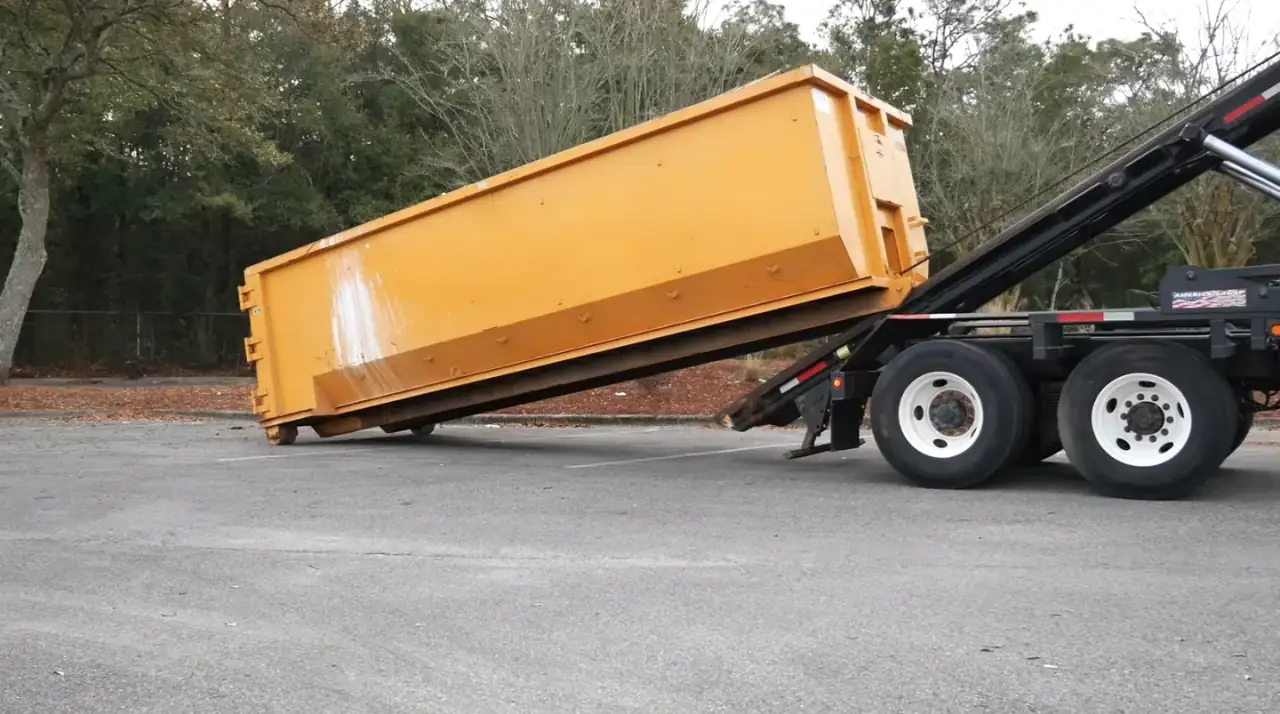
Here is exactly what to expect from a dumpster rental in Longview TX — from the first call to the empty driveway. Most dumpster rental companies tell you to call, book, and wait. They don’t tell you who dispatches the driver, where your debris goes, how the weight is measured, or what happens if something goes wrong. We do. Here is the complete process, step by step, with the operational details most operators keep to themselves.
Quote & Booking — Flat Rate Confirmed Before the Call Ends
When you call or submit the contact form, you reach the dispatch team directly — not a national call center that farms your job to a local hauler. The owner-operated team that confirms your order is the same team that assigns the driver.
The six things we confirm at booking
- Delivery address — including any rural route, gate code, or subdivision access note
- Debris type — household junk, roofing shingles, concrete, mixed construction, or a combination (debris type affects which containers are available and whether weight will be a factor before volume)
- Container size — 10-yard, 20-yard, or 30-yard; we recommend based on your project description if you’re unsure
- Preferred delivery date — same-day available for orders placed before noon; 1–2 days advance notice locks your size for peak periods
- Placement location — driveway, side yard, job site; if the truck has a tight approach angle from the street, note it now
- Access complications — locked gates, low-clearance structures, overhead lines, vehicles that need to be moved
By the end of this call, your flat rate is confirmed in writing. See our full pricing breakdown for what every line item covers. The only possible addition at invoice is a weight overage — and you are told the per-ton overage rate before the call ends, not after pickup.
What a broker gets wrong at this step
A national aggregator collects your order and passes it to a local hauler. The hauler may price it differently than what you were quoted. Access notes entered into a call center system may never reach the driver. The confirmed price is a range, not a flat rate. For our dumpster rental Longview customers, we eliminate this by being the operator and the dispatcher.
Dispatch & Confirmation — Your Notes Reach the Driver
After the call, your job is logged and assigned to a driver. You receive written confirmation with your delivery window — morning or afternoon — and the flat rate that was quoted.
Dumpster Delivery Process in Longview TX — From Dispatch to Pickup
- Job logged with all six booking data points attached
- Driver assigned and briefed directly on your site notes — tight driveway, gate code, overhead clearance, vehicles to work around
- Route planned based on delivery windows for the day
- Confirmation sent to you with your window and the confirmed flat rate
If anything changes before delivery — you need to move the date, you discover a gate code that wasn’t mentioned, the placement spot has changed — call us. The adjustment goes directly to the driver assignment, not into a ticket queue.
Delivery — 30–60 Minute Pre-Call, Boards Down, Done in 15
The driver calls or texts 30 to 60 minutes before arrival. You do not need to be home — as long as the placement spot is clear and the access path is unobstructed, the driver handles the drop without you present.
What the truck requires
- 60 feet of clear length in front of the drop location — this is the swing room the truck needs to position the container
- 10.5 feet of width — most standard driveways clear this without issue
- 25 feet of vertical clearance — common obstructions: low-hanging tree branches, power lines, basketball hoops, carport beams
If anything in your space approaches these limits, mention it at booking so we can advise before sending a truck. A failed delivery because the truck physically cannot access the spot results in a trip fee — preventable with a 30-second description at booking. See the full dumpster delivery tips checklist before your delivery date.
Driveway board placement
Before the container is set down, the driver places protective boards on your driveway surface. The boards distribute the container’s weight across a larger footprint to reduce the risk of concrete cracking or asphalt scuffing. This is standard professional practice. It is not an upsell or an optional add-on — it’s part of every residential delivery.
For estate executors, property managers, and absent owners
You do not need to be on-site during delivery. Provide the address, placement location, any gate code, and a phone number that will receive the driver’s pre-arrival call. Out-of-state family members coordinating an estate cleanout, property managers handling a rental property, and contractors working on behalf of a homeowner all use this routinely. The driver handles the drop; you get a confirmation text when it’s done.
What goes wrong without the pre-arrival call
If the driver arrives and your car is blocking the drop spot, or a vehicle was parked in the driveway after you left for work, the driver cannot complete the delivery. A trip fee is charged and the delivery reschedules to the next available window, pushing your project start by a day. The 30–60 minute call is the window to clear the spot before the truck arrives.
Your 7-Day Rental Window — Three Rules That Prevent Invoice Surprises
Your rental window starts at delivery and runs for seven days. Fill at your own pace — there are no check-in calls, no mid-rental inspections, no pressure to report progress. Three rules keep the rental from producing a bigger invoice than you expected.
Rule 1 — Do not fill above the rim line
The driver cannot legally transport a container with debris piled above the rim. If the container is overfilled when the driver arrives for pickup, you will be asked to remove the excess before pickup can proceed. This delays your pickup and your project. The rim line is the limit — not a guideline.
Rule 2 — Call before the window closes to extend, not after
If your project is running long and you need more than seven days, call us before the window closes — not after the driver has already come for pickup. Extensions are available at the daily rate stated in your agreement. A call the morning of day seven is fine. A call the morning of day eight, after we have already scheduled pickup, is not.
Rule 3 — Call immediately if you accidentally place a prohibited item
Prohibited items — paint cans, motor oil, propane tanks, automotive batteries, tires, refrigerants, wet concrete, and similar hazardous materials — cannot go to the disposal facility. If a prohibited item is discovered at the facility after pickup, additional handling and disposal fees apply. If you call us before pickup, we can advise on how to remove or properly dispose of the item before the driver arrives. Handling it before pickup is always less expensive than discovery at the facility.
Pickup — Same Protocol as Delivery
Pickup is triggered one of two ways: you call when you are done filling, or we come on day seven. Either way, the same 30–60 minute pre-arrival call applies. You do not need to be present.
- Driver calls or texts 30–60 minutes before arrival
- Container rolled back onto the truck — takes 10–15 minutes
- No assembly or disassembly required on your end
- Driveway boards removed as part of the pickup
If you finish your project early and want the container off your driveway ahead of day seven, call for early pickup. You will pay for the standard 7-day window — pricing covers the rental period, not the volume used — but we will schedule removal as soon as the route allows.
Where Your Debris Goes — Third-Party Documented
Most dumpster companies say “we haul it away” and stop there. Here is where it actually goes.
After pickup, the container is transported to Pine Hill Landfill, operated by Republic Services, 1102 Four S Industrial Blvd, Kilgore TX — a TCEQ-permitted Type I landfill (permit MSW-1327B) that accepts household and construction debris. It is a licensed, regulated facility, not an informal dump site.
How your weight is measured
The container is weighed at the facility’s certified truck scale when it enters. This is the only point at which your load weight is measured — it cannot be known before this point. Neither the driver nor we estimate it. A weight ticket is issued by the facility as the official record of your load’s tonnage. That ticket is the basis for any overage calculation.
Why naming the facility matters
A direct operator who uses a licensed facility can name it. A broker routing your debris through an unknown local hauler cannot tell you where it ends up. If your debris is hauled to an unlicensed dump site, the paper trail can trace back to your address as the point of origin. We are not a broker. We know where it goes because we take it there.
What “we haul it away” actually means for some operators
Brokers and aggregators book your order and pass it to whoever is available at the price that works. The local hauler who picks up the container decides where it goes. You have no visibility and no documentation. If the hauler uses an unlicensed site, that decision is out of your hands but potentially connected to your address as the origin point. Pine Hill Landfill with a Republic Services scale ticket is documentation.
Final Invoice — One Possible Variable, Disclosed at Booking
Weight is confirmed within 24 to 48 hours of pickup, once the scale ticket is processed. Your final invoice reflects one of two outcomes:
- Load within the included weight allowance: No additional charge. You pay the flat rate confirmed at booking. Nothing else.
- Load exceeds the weight allowance: The overage is calculated at $65 per ton, the rate stated in your agreement at booking — the rate you were told before the call ended — and added to your final invoice, accompanied by the facility scale ticket as documentation.
Those are the only two outcomes. No fuel surcharges. No environmental fees. No delivery and pickup billed separately. No specialty item fees that weren’t discussed at booking. A flat rate with one disclosed variable is the complete pricing model.
If you receive an overage charge and want to verify it
Request the scale ticket. The weight is measured by Republic Services at their certified facility scale, not estimated by us or reported by the driver. The scale ticket shows the gross weight, tare weight, and net load weight. If a number on your invoice does not match the ticket calculation, that is a billing error and we will correct it.
What the Wrong Booking Costs You
The difference between booking with a direct operator and booking through a broker or national aggregator is not visible in the online quote. It shows up in six specific failure modes.
Broker gives a range quote → invoice doesn’t match
National aggregators quote a price range and pass the job to a local hauler. The hauler may price it differently. What you were quoted is not what the driver’s company charges. The discrepancy shows up on the final invoice.
Access notes stay in the call center → driver arrives unprepared
You described the locked gate, the low overhead branch, and the tight driveway angle to the booking agent. That information lives in a call center system. The local driver who shows up may have none of it. The result is a failed delivery, a trip fee, and a rescheduled start date for your project.
No pre-delivery call → you wait all day, spot is blocked
Without a 30–60 minute pre-arrival call, you have no window to clear the placement spot before the truck arrives. The driver cannot access it, cannot complete the delivery, and leaves. Trip fee charged. Project delayed.
Wrong size delivered → one day lost on an exchange
A broker agent who does not ask the right questions about debris type, project scope, and material weight delivers the wrong size. A container that is too small runs out before the project is done; one that is too large cost more than the job needed. A same-day exchange is rarely possible — it typically costs a day and a second delivery fee.
No disposal transparency → you don’t know where your debris went
“We haul it away” tells you nothing. A broker cannot tell you which facility the local hauler uses, whether it is licensed, or whether C&D debris was disposed of correctly. We use Pine Hill Landfill, Republic Services, 1102 Four S Industrial Blvd, Kilgore TX. A licensed facility. A certified scale. A weight ticket.
No weight documentation → you cannot verify an overage charge
If an operator self-reports your weight, you have no third-party basis to dispute the number. Our weight overages are calculated from a scale ticket issued by Republic Services. If you question the number, you can see the ticket.
Broker vs. Direct Operator — The Difference on Your Invoice
| Factor | National Broker / Aggregator | Direct Operator (Us) |
|---|---|---|
| Who answers when you call | National call center; no site knowledge | The dispatch team that runs your job |
| Pricing at confirmation | Range or “quote pending” — local hauler may price differently | Flat rate confirmed before the call ends |
| Where your access notes go | Call center system; may not reach the driver | Driver briefed directly before dispatch |
| Pre-delivery communication | Depends on the local hauler’s protocol | 30–60 min call or text, every delivery |
| Where your debris goes | Up to the local hauler — undisclosed | Pine Hill Landfill, Republic Services, Kilgore TX |
| How weight overages are calculated | Estimated or self-reported by operator | Certified third-party scale ticket from the facility |
| What you can verify afterward | Nothing independently documented | Scale ticket, written confirmation, flat rate on file |
Our Dumpster Rental Process in Longview, TX: FAQs
What if I need to reschedule after confirming my order?
Call us before your scheduled delivery window. Rescheduling is handled directly with the dispatch team that took your original order — no ticket system, no call center to navigate. We adjust the driver assignment and send you an updated confirmation with the new window.
Can I get a specific delivery time instead of a morning or afternoon window?
We offer morning and afternoon windows rather than timed appointments because route sequence depends on traffic, access conditions, and the order of other deliveries that day. The 30–60 minute pre-arrival call gives you a real-time narrow window without committing to a clock time we may not hit. If your project has a hard start that depends on the container being on-site, tell us at booking and we will position you as early in the route as we can.
Do I need to be home for delivery or pickup?
No. As long as the placement spot is clear and the access path is unobstructed, the driver handles the delivery without you present. The same applies to pickup. Estate executors, property managers, and out-of-town families clearing a property use this routinely. Provide any gate codes or access notes at booking so the driver is briefed before arrival.
How do I verify a weight overage charge if it looks wrong?
Request the scale ticket. Your load is weighed by Republic Services at their certified facility scale — not estimated by the driver or calculated by us. The scale ticket shows gross weight, tare weight, and net load weight. If a number on your invoice does not match the ticket calculation, that is a billing error and we will correct it.
What if the driver cannot access my placement spot when they arrive?
The driver will call you before attempting to leave. A failed delivery fee applies only when access is blocked and we cannot reach you to resolve it. The 30–60 minute pre-arrival call exists partly to catch this situation while you still have time to clear the spot. If your driveway or entry has an unusual constraint — tight angle, low clearance, vehicles that need to move — describe it at booking so we can advise before the truck rolls.
Can a property manager or family member be the contact instead of the property owner?
Yes. We work with whoever is coordinating the project. Estate executors, contractors managing a job for a homeowner, and property managers for rental properties all book and coordinate directly with us. We need one reliable contact for pre-delivery and pre-pickup calls — that person does not need to be the property owner.