
Knowing what can go in a dumpster before you book saves you from contamination fees and rejected loads at the landfill. Most material from residential and construction projects goes in without issue. The exceptions are specific — and most of them come down to two categories: hazardous liquids and items with regulated disposal streams under Texas law. The same rules apply to every dumpster rental in Longview TX and across Gregg County.
Call us before loading anything you are unsure about. Pine Hill Landfill’s acceptance rules govern what is finally accepted.
What Is Allowed in a Dumpster in Longview, TX: Accepted Materials
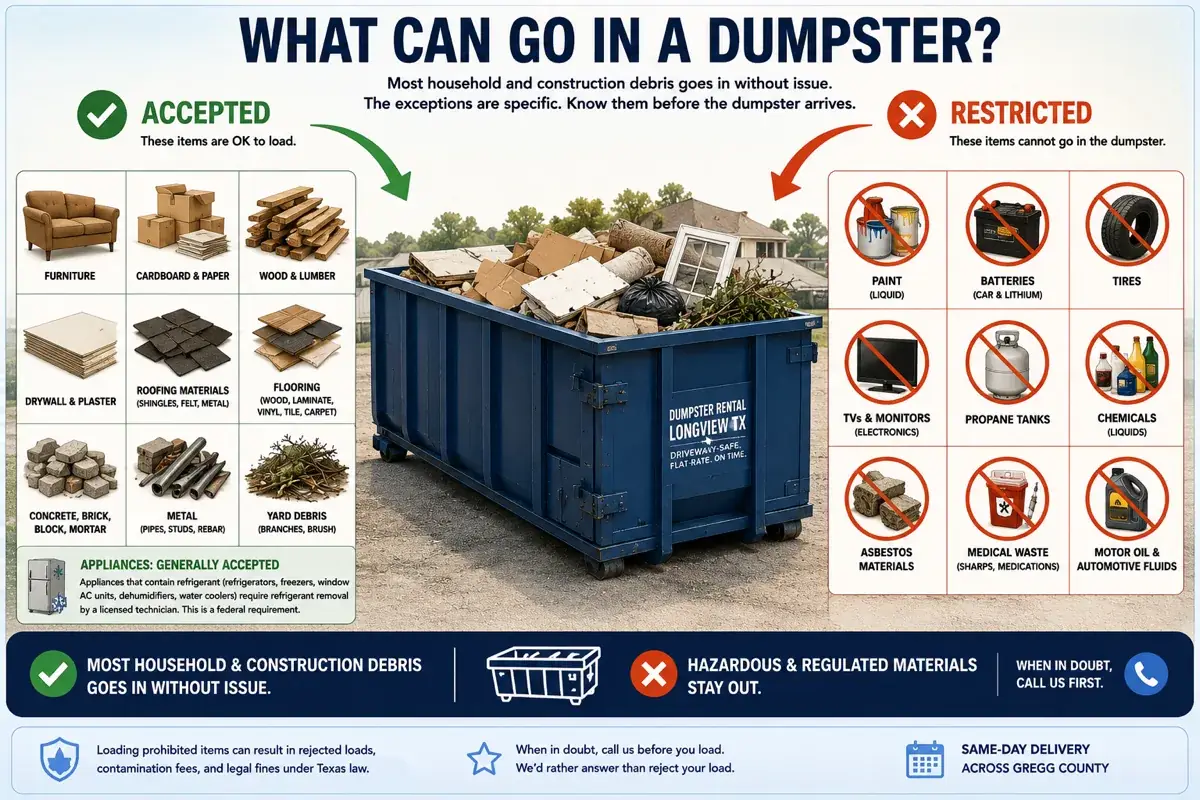
Standard household and construction debris goes in without issue. This includes furniture (sofas, mattresses, bed frames, tables), clothing and textiles, cardboard and paper, general household junk, wood (dimensional lumber, plywood, engineered wood), drywall and plaster, flooring (hardwood, laminate, vinyl, carpet, ceramic tile), roofing materials (shingles, felt, metal), concrete, brick, block, and mortar, windows and doors, metal (pipes, framing studs, rebar), insulation, and yard debris including branches and brush.
Appliances are generally accepted with one important exception: any appliance that contains refrigerant — refrigerators, freezers, window air conditioners, dehumidifiers, and water coolers — requires refrigerant removal by a licensed technician before disposal. The refrigerant removal is a federal requirement under the Clean Air Act, not a company policy. Most appliance retailers handle this when they deliver a replacement unit.
What cannot go in a dumpster
The following categories are restricted from roll-off containers under Texas law, TCEQ rules, or the landfill’s acceptance policy:
Hazardous liquids and chemicals
Liquid paint (both latex and oil-based), motor oil and automotive fluids, solvents, fuels, pesticides, herbicides, pool chemicals, and cleaning products in liquid form. These are classified as household hazardous waste and require separate disposal. The City of Longview accepts these materials at periodic household hazardous waste and Community Recycling Day events — check longviewtexas.gov for current dates.
Regulated building materials
Asbestos-containing materials (common in pre-1978 homes — insulation, floor tiles, roofing felt, popcorn ceilings) require licensed abatement and separate disposal. CCA-treated lumber (the pressure-treated green-tinted wood used in ground-contact applications) contains arsenic and chromium and cannot go in a standard container.
Electronics
Texas restricts certain electronics from landfill disposal under the Texas E-Cycles program. Televisions, desktop computers, laptops, and monitors cannot go in a roll-off dumpster. Take them to a certified e-waste recycler in the Longview area. Printers, small appliances, and phones are generally accepted.
Tires
Tires are banned from Texas landfills. Most tire retailers accept old tires for a small fee when you purchase replacements.
Batteries
Lead-acid car batteries are accepted for recycling at most auto parts stores in Longview at no charge. Lithium batteries (from power tools, electronics, e-bikes) have become a significant fire hazard in roll-off containers and are restricted. Do not put them in the dumpster.
Medical waste
Needles, sharps, and prescription medications cannot go in a dumpster. The Longview Police Department has a DEA Drug Take Back drop box at their lobby. Sharps require a sharps disposal container available at most pharmacies.
Propane tanks
Even empty propane tanks — grill cylinders, camping canisters — cannot go in the container. Most propane retailers and hardware stores handle tank disposal or exchange.
Railroad ties
Railroad ties — old or new — are treated with creosote, a coal-tar derivative classified as a hazardous material under TCEQ guidelines. They cannot go in a standard roll-off container regardless of quantity. If you are clearing a rural East Texas property with old railroad tie fencing, landscaping timbers, or a garden border, contact a licensed hazardous material hauler for separate disposal before the dumpster arrives.
Conditional items — it depends
Some materials are neither clearly accepted nor clearly restricted — the answer depends on the condition, quantity, or preparation of the item.
Aerosol cans. Empty aerosol cans with no remaining pressure are accepted. Full or partially full pressurized cans are not — they are a puncture and fire risk in a compacting truck. Test before loading: if you can hear liquid sloshing or the nozzle still releases pressure, do not put it in the container. The Gregg County Household Hazardous Waste program accepts unused aerosol products at collection events.
Mattresses and box springs. Accepted in Gregg County. Some Texas jurisdictions route mattresses to recycling facilities, which is why some national rental companies flag them as restricted — it is a regional policy difference, not a universal rule. In our service area they go in the container without issue. They are bulky but light — not a weight concern.
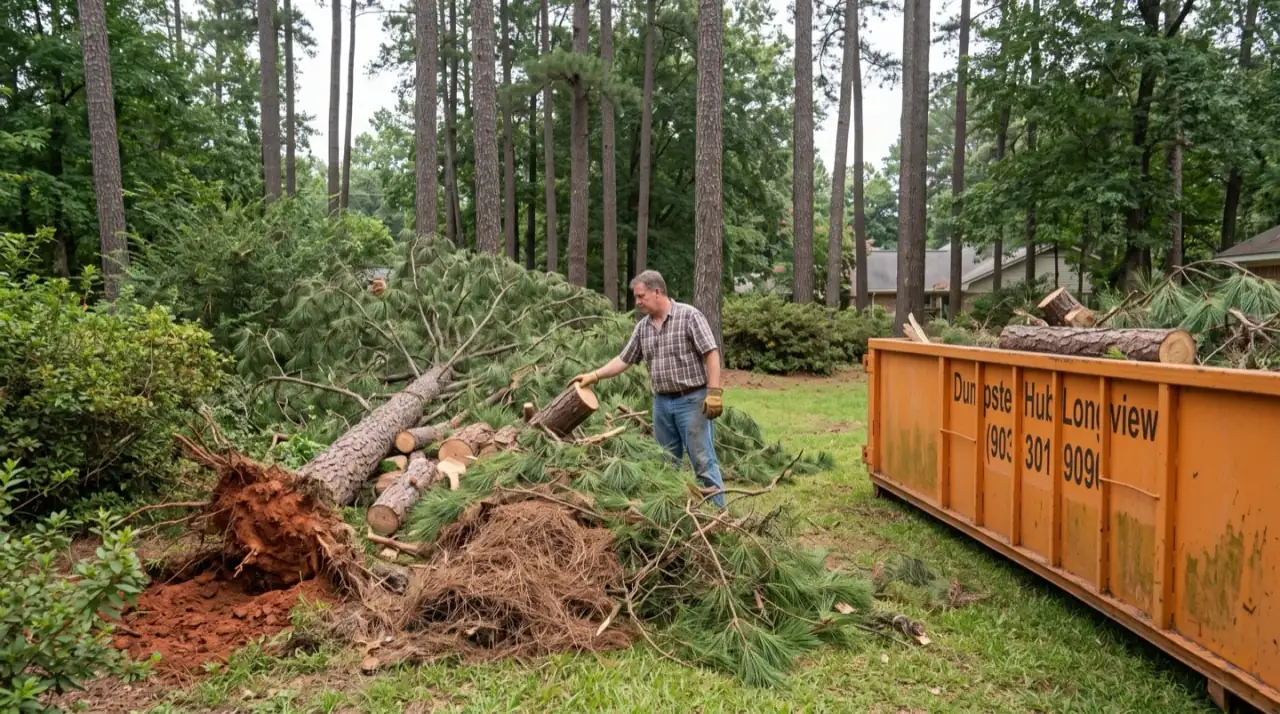
Tree stumps. Accepted. The weight is the planning consideration: a mature loblolly pine stump in East Texas weighs 300 to 500 pounds depending on diameter, and a large pecan or post oak can run heavier. If you are clearing more than two or three large stumps from a yard or rural property, call before loading so we can confirm the weight allowance for your container size.
Latex paint that has fully dried and hardened in the can is generally accepted in a dumpster as a dried solid — the same material in liquid form is not. To speed up drying: remove the lid, stir in an absorbent material — cat litter, commercial paint hardener, or sawdust — at roughly one part absorbent to one part paint, and leave it in a ventilated area. Small cans dry within a few hours using this method; larger quantities take longer. Once the surface is fully solid and the can is not runny when tipped, it can go in the dumpster.
Clean fill dirt and soil are accepted but are extremely heavy — roughly 2,700 pounds per cubic yard — and can push a container past its weight limit with a surprisingly small amount. Soil mixed with construction debris is generally fine. Contaminated soil near old fuel tank locations or industrial areas may require testing before disposal.
The weight-versus-volume trap with dense materials: Roofing shingles fill a container visually before approaching the weight limit — a 20-yard loaded with shingles often looks nearly full but stays within tonnage. Concrete and brick do the opposite: a container can look barely one-third full and already be overweight, because dense materials stack mass without stacking height. If your project involves concrete, brick, tile, or wet excavated East Texas clay, call before loading to confirm the weight allowance for your container size. The overage is calculated at the landfill after pickup — at that point there is nothing to be done about it.
Small amounts of treated lumber are typically manageable in a mixed load. Large quantities — a full deck teardown worth of CCA-treated wood — need separate handling.
Where to take restricted materials in Gregg County
How to dispose of what cannot go in a dumpster — Gregg County resources
For materials that cannot go in the dumpster, here are the local disposal options:
City of Longview hazardous waste events: Periodic collection and Community Recycling Day events accept paint, motor oil, pesticides, herbicides, pool chemicals, and most household hazardous waste. Check longviewtexas.gov for the next date.
Motor oil: AutoZone and O'Reilly Auto Parts locations in Longview accept used motor oil for recycling at no charge.
Medications: Longview Police Department DEA Drug Take Back drop box, available during business hours at the department lobby.
Car batteries: AutoZone, O'Reilly, and most auto parts retailers accept them for recycling at no charge, often with a core credit.
Electronics: Certified e-waste recyclers serve the Longview area — search Texas E-Cycles locator for the nearest drop-off.
Refrigerant removal: Appliance retailers and HVAC contractors licensed under EPA Section 608 can recover refrigerant before a unit is disposed of.
What to Put in a Dumpster in Longview, TX, by Project Type
Accepted materials vary by project type. The sections below break down what goes in and what stays out for the most common Longview TX jobs — renovation, roofing, estate cleanout, and construction — so you can load without stopping to check.
The permitted materials list above answers the rule. This section answers the real question: given the specific project you are doing, what goes in and what does not? The exceptions cluster around a small number of job types.
Kitchen gut renovation. Cabinets, countertops, drywall, underlayment, vinyl composition tile, laminate flooring, fixtures, and sinks go in without issue. The weight profile on a 1980s or 1990s drywall kitchen is manageable — drywall runs 1.6 lbs per square foot, and a full kitchen gut on a 1,400 sq ft ranch typically produces 1.5 to 2 tons, inside a 10-yard's 2-ton allowance. What does not go in: liquid paint left in cans, aerosol cans, any appliance containing refrigerant (refrigerators, wine coolers, under-counter units), and fluorescent tubes from under-cabinet lighting.
Bathroom renovation. Mortar-set tile and the mortar bed beneath it are accepted — but they are heavy. A single mortar-bed shower floor can weigh 800 to 1,200 pounds. Cast iron tubs run 250 to 350 pounds each. A bathroom gut with mortar walls, cast iron tub, and floor tile can approach the weight limit faster than the volume suggests. Size by weight, not by how much visual space you are clearing. What does not go in: mercury-containing thermostats (older homes), fluorescent vanity bulbs, and liquid cleaning chemicals.
Roofing tear-off. Asphalt shingles, fiberglass shingles, roofing felt, metal flashing, ridge cap, and wood decking all go in. Shingles are less dense than concrete — a 10-yard loaded with shingles fills visually before hitting the weight limit for most residential roofs. The exception is a re-roof over an existing layer: two layers of shingles plus decking replacement on a larger roof can push toward the 2-ton limit on a 10-yard. On any roof over 2,000 square feet or with more than one existing layer, the 20-yard is the safer call. What does not go in: pipe jack boots containing lead (common on pre-1980 roofs — they are restricted as lead-containing material), and asbestos-bearing roofing felt found under multiple layers on pre-1978 structures.
Flooring replacement. Hardwood, engineered wood, laminate, carpet and pad, ceramic tile, and vinyl plank all go in. The weight variable is ceramic or porcelain tile — at roughly 3 to 4 lbs per square foot for tile plus an equal weight of thinset beneath it, a 600 square foot floor generates 3,600 to 4,800 pounds of tile debris alone, over the 2-ton weight allowance on a 10-yard container. Tile jobs in East Texas consistently produce the most overage fees of any residential project type. If you are pulling ceramic or stone tile over thinset, size up regardless of the room count.
Estate and property clearout. Furniture, mattresses, clothing, household goods, small appliances (except those with refrigerant), boxes, books, sporting goods, tools, and general accumulated contents go in. What does not go in: televisions and computer monitors (Texas E-Cycles restriction), propane cylinders including grill tanks and camping canisters, car batteries, lithium batteries from power tools or e-bikes, liquid paint or chemicals, and medications. Estate clearouts in homes built before 1978 may also contain items with asbestos or lead that require separate handling — popcorn ceiling material, old floor tile adhesive, and pipe insulation are the most common sources.
Concrete and demolition. Concrete, brick, block, mortar, and excavated soil go in — but weight is the only constraint that matters for these materials. Concrete weighs approximately 4,000 pounds per cubic yard. A 10-yard container holds roughly 10 cubic yards of volume, but its 2-ton weight allowance is exhausted by less than 1.5 cubic yards of solid concrete. The practical rule: concrete and brick jobs should never fill a container more than one-third by volume, or you will exceed the weight limit before the container looks full. For any job with significant concrete volume, call before loading so the weight allowance can be matched to the actual debris quantity.
Understanding what can go in a dumpster in Longview, TX before you schedule delivery is the single most effective way to avoid contamination fees and rejected loads at the landfill. The vast majority of residential and construction debris goes in without issue — furniture, drywall, roofing shingles, concrete, yard debris, and general household junk. What cannot go in a dumpster comes down to a short, specific list: hazardous liquids, regulated electronics, propane cylinders, batteries, and items with restricted disposal streams under Texas law. When a material falls in a gray area, call before you load rather than finding out at pickup.
Frequently Asked Questions
Is it illegal to throw away a TV in Texas?
Yes. Televisions are banned from landfill disposal in Texas under the Texas E-Cycles program and cannot go in a roll-off dumpster or standard trash. The same restriction applies to desktop computers, laptops, and monitors. Take them to a certified e-waste drop-off — use the Texas E-Cycles locator at texasrecycles.com to find the nearest site. Printers, small appliances, and phones are generally accepted in a dumpster.
Can I put dirt and soil in a dumpster?
Clean fill dirt is accepted but is very heavy — roughly 2,700 pounds per cubic yard. A small volume of soil can push a container past its weight allowance quickly. Contaminated soil near old fuel tanks or industrial sites requires testing and separate disposal. Call us before including significant amounts of soil so we can advise on the weight impact.
What happens if I put something restricted in the dumpster?
If restricted materials are found at the landfill, the load may be rejected and returned, or you may be charged a contamination fee on top of standard disposal costs. Hazardous materials improperly disposed of can also result in fines under TCEQ regulations. When in doubt, call us before loading anything you are unsure about — we would rather answer the question than deal with a rejected load.
Can I put paint in a dumpster?
Liquid paint — both latex and oil-based — cannot go in a dumpster. It is classified as hazardous waste. Latex paint that has completely dried and hardened in the can is generally accepted as a dried solid. To dry it yourself: remove the lid and stir in cat litter, paint hardener, or sawdust at a one-to-one ratio, then leave it in a ventilated area until fully solid. Oil-based paint cannot be dried this way and must go to the Gregg County Household Hazardous Waste program regardless.
Is using a private dumpster illegal in Texas?
Yes. Using a dumpster you did not rent — a neighbor's container, a business's bin, or a construction site dumpster — is theft of services under Texas Penal Code § 31.04. It does not matter whether the container looks empty or barely used. If you need a roll-off for a project, renting your own starts at $325 for a 7-day period including delivery, pickup, and a 2-ton weight allowance. Same-day delivery is available in Gregg County for orders placed before noon.
Is illegal dumping a felony in Texas?
It can be. Under Texas Health and Safety Code § 365.012, illegal dumping starts as a Class C misdemeanor for small amounts and escalates to a state jail felony for dumps exceeding 500 pounds or 100 gallons — or any quantity of hazardous waste. Fines range from hundreds to thousands of dollars and convictions can carry jail time. In East Texas, dumping debris on FM roads or rural county routes is one of the more commonly cited violations. A roll-off dumpster rental starting at $325 sends your debris to a licensed facility under TCEQ guidelines and removes the legal exposure entirely.